Category: Assessments

  • Why Spanish Training Courses Matter for Compliance

    Why Spanish Training Courses Matter for Compliance

    Regulatory agencies like OSHA don’t just recommend that employers provide training workers can understand—they require it. OSHA’s guidelines explicitly state that safety training must be presented in a language and vocabulary workers can comprehend.

    This means if your Spanish-speaking employees can’t fully understand their compliance training, your organization may be at risk for:

    • Regulatory citations and fines
    • Failed audits
    • Increased liability in the event of workplace incidents
    • Lower overall compliance rates

    Spanish-language compliance courses ensure your team understands critical regulations—whether you’re covering hazard communication, lockout/tagout procedures, or industry-specific standards. When employees truly grasp the “why” behind the rules, compliance becomes second nature, not a checkbox exercise.

    Safety Training That Actually Protects
    Let’s talk about what’s really at stake: people’s well-being.

    Frontline workers in manufacturing, warehousing, food processing, and similar industries face real hazards every day. Machinery, chemicals, heavy equipment, repetitive motions—the list goes on. Effective safety training can mean the difference between a worker going home healthy and a preventable injury.

    But here’s the thing: safety training only works when workers understand it completely. When instructions about emergency procedures, PPE requirements, or equipment operation are delivered in an unfamiliar language, crucial details can get lost.

    Spanish safety training courses address this directly by providing:

    • Clear explanations of workplace hazards in workers’ native language
    • Step-by-step procedures they can confidently follow
    • Visual demonstrations paired with Spanish narration for better retention
    • Accessible resources workers can reference when questions arise
    • When your employees fully understand how to protect themselves and their coworkers, everyone benefits—including your organization’s safety record and insurance costs.

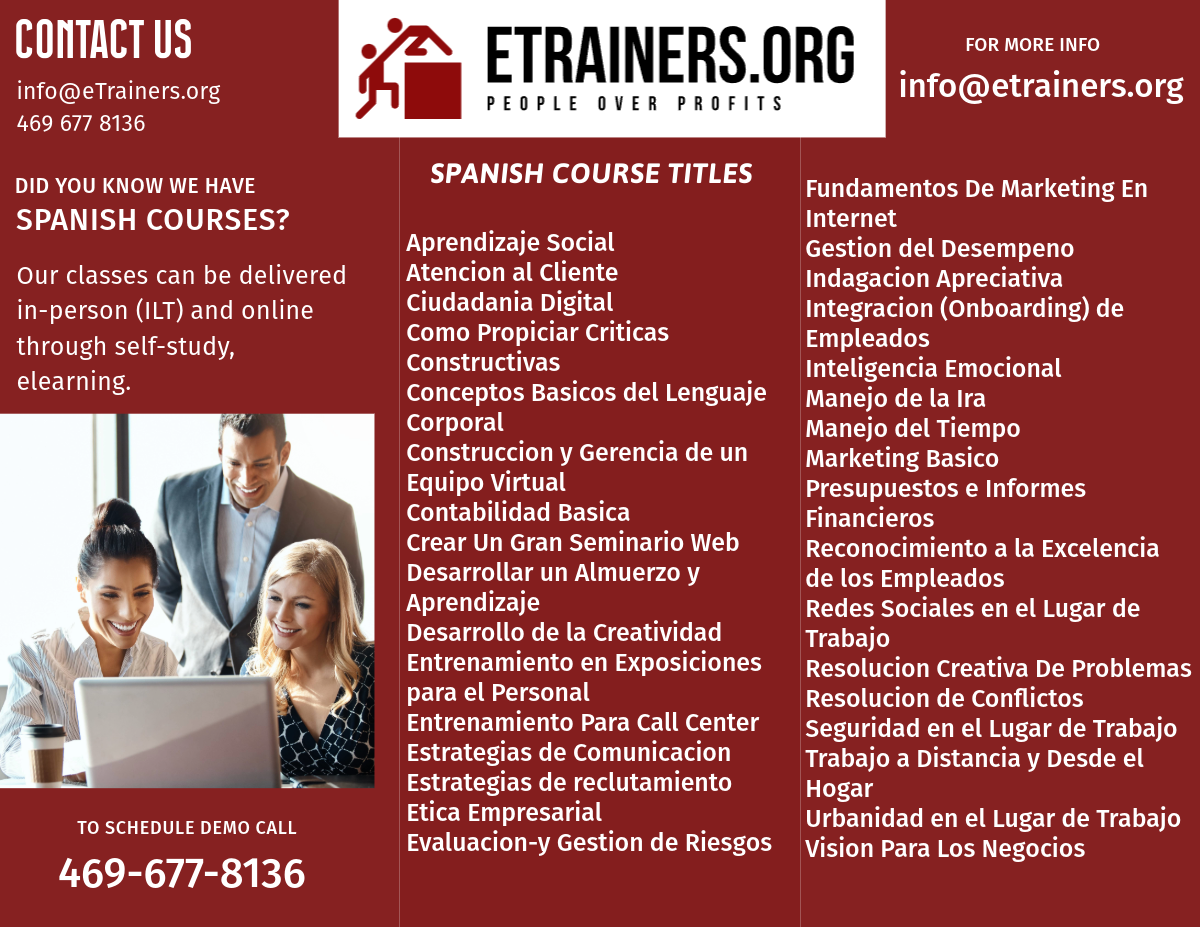
    Visit our Learning Solutions Library for Spanish course descriptions and objectives.

    Book your meeting for your hands-on exploration of our courses.

    Home » Assessments
    Are you not sure where to start?

    Start with our skill gap assessments – they are in Spanish too.

  • Breaking Down Learning Barriers with Spanish Courses

    Breaking Down Learning Barriers with Spanish Courses

    Why Spanish-Language Training Courses Matter for Your Workforce

    When it comes to workplace safety, compliance, and operational excellence, clear communication isn’t just important—it’s essential. Yet for millions of Spanish-speaking frontline workers across the United States, critical training often arrives in a language that creates barriers rather than bridges.

    The solution? Spanish-language training courses designed specifically for the industries and roles where they’re needed most.

    The Reality: A Diverse Workforce Deserves Inclusive Training
    According to the U.S. Bureau of Labor Statistics, Hispanic and Latino workers make up a significant and growing portion of the American workforce—particularly in manufacturing, construction, warehousing, and other frontline industries. Many of these workers are bilingual, while others are more comfortable learning and retaining information in Spanish.

    Here’s the challenge: when training materials only exist in English, comprehension gaps can emerge. And in high-stakes environments where compliance violations carry hefty fines and safety lapses can cost lives, those gaps become serious risks.

    The bottom line? Offering training in your employees’ preferred language isn’t just a nice gesture—it’s a strategic investment in your organization’s safety, efficiency, and legal standing.

    Start with our skill gap analysis (Spanish version).

    Sign up to view our Spanish course descriptions and objectives, and schedule your personal tour of our catalog.

    Book a 15-minute call:

  • Group Coaching and Customizations – Our Minimum Delivery Standards

    Group Coaching and Customizations – Our Minimum Delivery Standards

    The Prerequisite for Practice

    When organizations embark on change initiatives, training often becomes the default destination—a checkbox to mark complete before moving on. But in the ATCM model, Training (the “T”) serves a fundamentally different purpose: it’s the prerequisite for practice, not the end goal.

    This distinction matters more than you might think. When we treat training as the finish line, we burden employees with exhaustive content dumps, marathon workshops, and information overload that leaves them too fatigued to actually apply what they’ve learned.


    The Problem with Traditional Training Approaches

    Let’s be honest about what’s broken:

    Cognitive overload is real. Research consistently shows that our working memory can only hold so much before new information starts pushing out what we just learned. Yet traditional training programs routinely ignore this, cramming hours of content into single sessions.

    Change fatigue compounds the problem. Your employees aren’t just dealing with this training—they’re navigating competing priorities, ongoing operational demands, and often multiple change initiatives simultaneously. Every minute spent in non-essential training is a minute stolen from meaningful work.

    The forgetting curve is unforgiving. Within 24 hours, people forget approximately 70% of new information. Within a week, that number climbs to 90%. So why do we design training as if a single exposure creates lasting competence?


    eTrainers.org’s eLearning Approach

    The solution isn’t more training—it’s smarter, more purposeful training that respects both cognitive science and business realities.

    Microlearning: The Foundation Framework

    Instead of comprehensive courses that cover everything, purposive eLearning focuses on delivering the basic framework—the essential knowledge scaffolding employees need to begin practicing effectively.

    Think of it this way: you don’t need to memorize an entire cookbook to make dinner. You need to understand basic cooking principles and have a recipe handy. Training should provide the principles; practice develops the expertise.

    Effective microlearning modules:

    • Target 5-15 minutes of focused learning
    • Address one concept or skill at a time
    • Provide immediate relevance to daily work
    • Create space for reflection and application

    Right-Sizing Content to Business Impact

    Not all knowledge carries equal weight. Purposive eLearning demands that we ruthlessly prioritize:

    High PriorityLower Priority
    Skills directly tied to workflow changesBackground theory and history
    Decision-making frameworksEdge cases and exceptions
    Core processes and protocolsNice-to-know supplementary content
    Compliance essentialsAdvanced techniques (save for later)

    By focusing training on high-impact workflow redesign, organizations ensure employees spend their learning energy where it matters most.


    Strategic Benefits of Purposive Training

    1. Preserved Energy for Practice

    When training is lean and focused, employees arrive at the practice phase with mental bandwidth intact. They’re ready to experiment, make mistakes, and build genuine competence—rather than simply trying to remember what they learned in a three-hour webinar.

    2. Faster Time to Application

    Microlearning modules can be deployed rapidly and consumed immediately before task execution. This “just-in-time” approach closes the gap between learning and doing, dramatically improving retention and transfer.

    3. Reduced Resistance to Change

    Change fatigue often masquerades as resistance. When employees face yet another lengthy training requirement, their pushback isn’t about the content—it’s about the burden. Purposive eLearning respects their time and intelligence, reduces friction, and builds goodwill.

    4. Measurable Business Outcomes

    Because purposive training ties directly to specific workflow changes, its impact becomes measurable. You can track whether employees successfully apply the framework in practice, rather than simply whether they completed a course.


    Building Your Purposive Learning Strategy

    Ready to transform your approach to the Training phase? Here’s where to start:

    Audit existing training for content that doesn’t directly support immediate application. Archive it for reference, but remove it from required learning paths.

    Map training to specific practice scenarios. Every module should answer: “What will the learner do differently after this?”

    Embrace flexibility. Self-paced, device-agnostic learning allows employees to engage when their cognitive resources are highest—not when a calendar invite demands it.

    Support hybrid and remote realities. Today’s workforce needs training that travels with them, accessible on any device, at any time.


    The Bottom Line

    Training isn’t transformation—it’s preparation. When we design the “T” phase of ATCM with this understanding, we create learning experiences that energize rather than exhaust, that focus rather than overwhelm, and that ultimately serve the business outcomes we’re chasing.

    The goal isn’t employees who’ve completed training. It’s employees who are ready to practice.


    Ready to Build a Smarter Training Library?

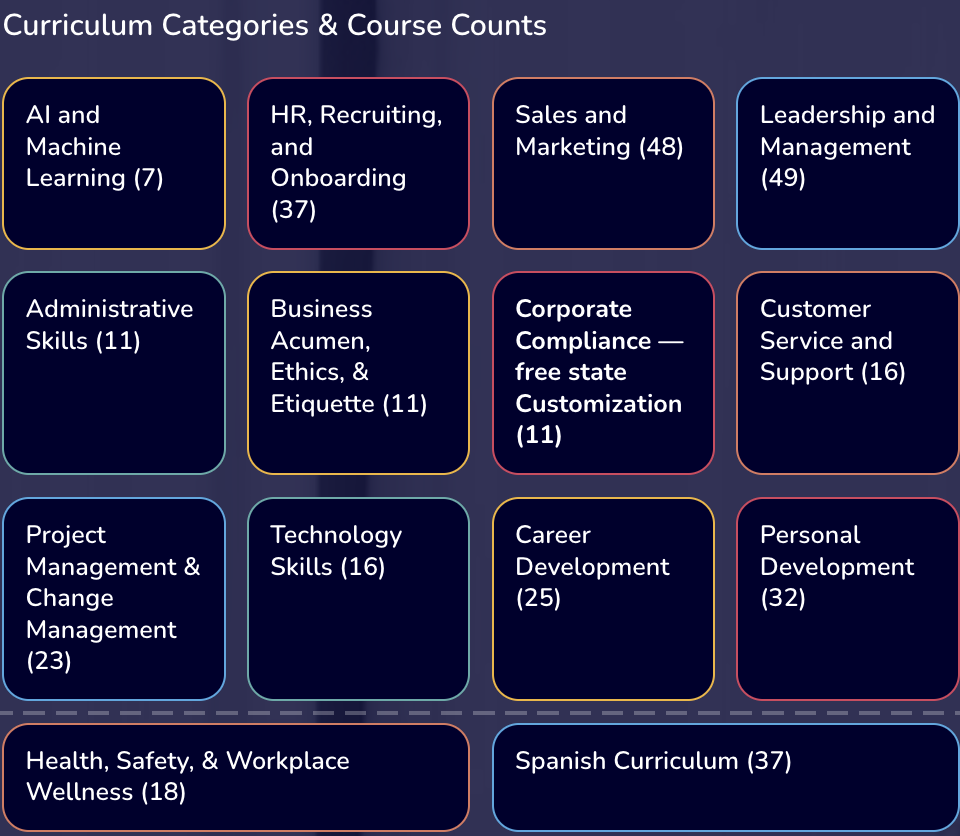
    Transform your workforce with affordable, focused learning solutions. The eTrainers.org Learning Solutions Library offers unlimited access to over 340 courses across today’s most in-demand competencies—from AI and machine learning to leadership, compliance, and beyond.

    At just $19.99/month per user, your team gets:

    ✓ Self-paced, microlearning-friendly content

    ✓ Flexible access on any device

    ✓ Categories spanning leadership, technology, project management, and more

    ✓ Solutions for enterprise, SMB, government, and nonprofit sectors

    Explore the Learning Solutions Library →

    Stop training for training’s sake. Start building the purposeful foundation your workforce needs to practice, adapt, and excel.

  • The Complete Guide to Measuring Training Effectiveness

    The Complete Guide to Measuring Training Effectiveness

    eTrainers.org Launches Revolutionary ATCM Model to Transform Professional Development

    September 8, 2026 – eTrainers.org is excited to announce the official launch of the ATCM Model, a comprehensive four-phase framework designed to revolutionize how organizations approach employee training and professional development when measuring training effectiveness.

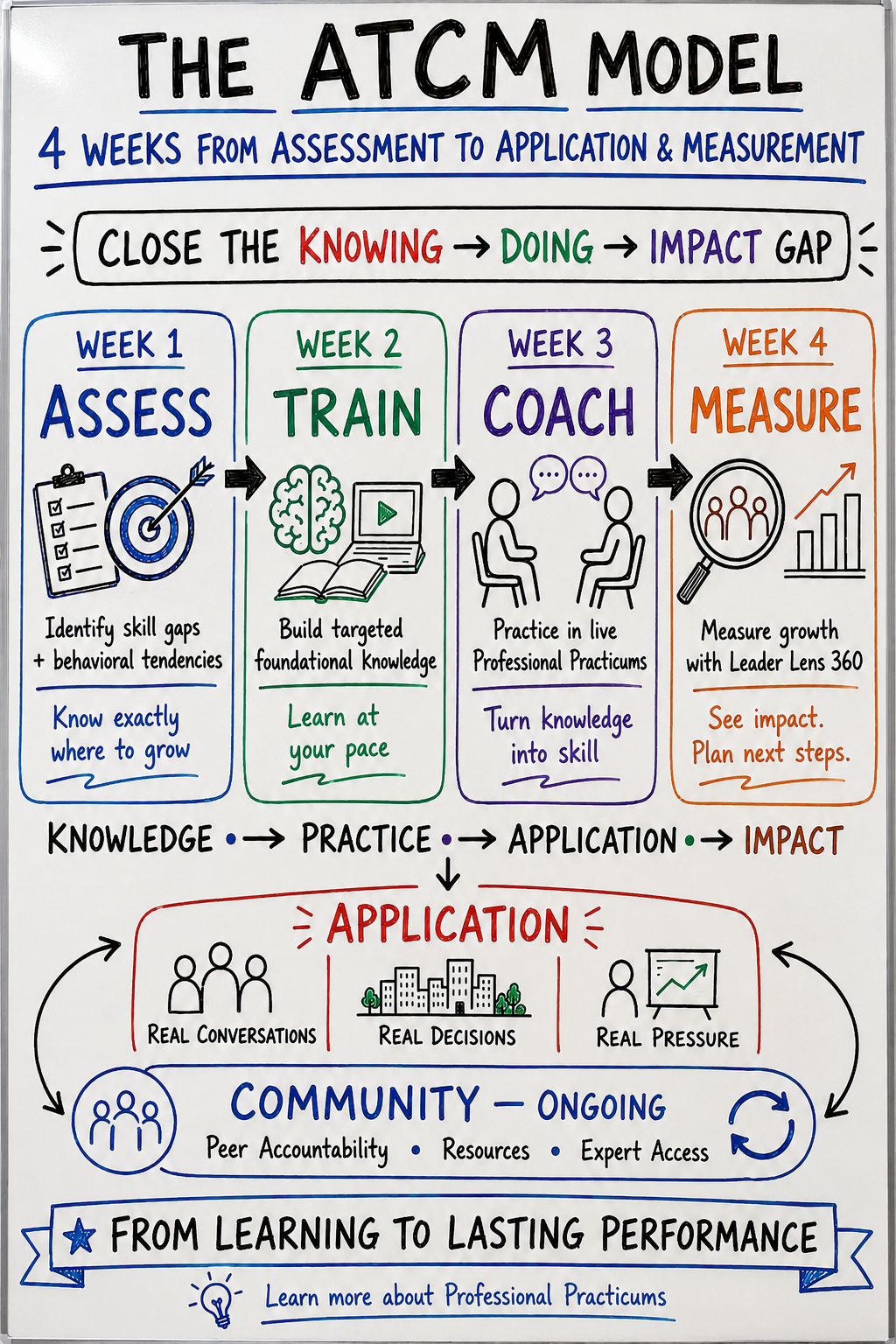
    Introducing the Assess – Train – Coach – Measure Model

    The ATCM Model provides a structured, cyclical approach to learning and development that ensures continuous improvement and measurable results. The four pillars of the framework include:

    • Assess – Evaluate current skill levels, identify gaps, and establish baseline performance metrics to create targeted development plans
    • Train – Deliver customized learning experiences and educational content tailored to address identified needs
    • Coach – Provide ongoing support, mentorship, and real-time guidance to reinforce training and support practical application
    • Measure – Track progress, evaluate outcomes, and analyze data to demonstrate ROI and inform future development cycles

    A Holistic Approach to Learning

    “Traditional training programs often fail because they lack follow-through and accountability,” said a spokesperson for eTrainers.org. “The ATCM Model closes the loop by integrating assessment, training, coaching, and measurement into one continuous cycle. This ensures that learning translates into real-world performance improvements.”

    Why ATCM?

    Organizations implementing the ATCM Model can expect:

    • Higher training ROI through targeted interventions
    • Improved employee performance with ongoing coaching support
    • Data-driven insights to guide future development investments
    • Sustainable growth through continuous feedback loops

    Availability

    The ATCM Model launches on September 8, 2026, and will be available to organizations of all sizes. For more information about implementation, certifications, and resources, visit eTrainers.org.


    Media Contact:
    eTrainers.org
    Email: info@etrainers.org
    Website: www.etrainers.org


    Book a 15-minute session to learn more.

    Home » Assessments
  • Assessment Center Services for Workforce Skills

    Assessment Center Services for Workforce Skills

    Why Assessments Are Your Secret Weapon Against Workplace Anxiety


    Change is hard. We all know this. But here’s what makes it even harder: walking into the unknown without a map.

    When organizations introduce new technologies—especially AI—employees often find themselves caught between excitement and fear. Will this tool help me work smarter, or will it replace me entirely? This isn’t paranoia. It’s a legitimate concern shared by 53% of employees who worry about being replaced by emerging technologies.

    The good news? There’s a proven way to transform that fear into confidence. It starts with something surprisingly simple: a diagnostic assessment.


    The Power of Knowing Where You Stand

    Effective change doesn’t begin with training. It begins with understanding.

    Think about the last time you learned something new. Whether it was a software platform, a teaching methodology, or a professional skill, the process probably felt overwhelming at first. Now imagine if someone had shown you exactly what you already knew and precisely what you needed to learn. Suddenly, that mountain looks more like a manageable hill.

    This is the principle behind diagnostic assessments, and it’s why the “Assess” phase of the ATCM (Assess, Train, Coach, Measure) model is so critical. Before anyone opens a training module or attends a workshop, we first need to establish a baseline. What skills do your people already have? Where are the gaps? What specific knowledge will move them from where they are to where they need to be?


    Connecting Assessment to Awareness: A Cognitive Bridge

    If you’re familiar with the ADKAR model—Awareness, Desire, Knowledge, Ability, Reinforcement—you know that awareness is the essential first step. People need to understand why change is happening before they can embrace it.

    Here’s where things get interesting: the “Assess” phase of ATCM acts as the cognitive foundation for ADKAR’s “Awareness” phase.

    When employees complete a thoughtful diagnostic assessment, several powerful things happen:

    1. They see their current capabilities clearly. This isn’t about highlighting weaknesses—it’s about creating an honest picture of their professional landscape.
    2. They understand what they need to learn. The mystery disappears. Instead of vague anxiety about “learning AI,” they know they need to master three specific skills.
    3. They recognize the gap is manageable. When the unknown becomes known, fear shrinks. A concrete learning path replaces the terrifying void of uncertainty.

    In other words, assessment doesn’t just inform training—it builds psychological safety.


    Reducing the Cognitive Load of the Unknown

    Let’s talk about cognitive load for a moment.

    When employees face organizational change without clear information, their brains work overtime trying to fill in the gaps. What will this mean for my job? How much do I need to learn? Am I capable of this? What if I fail?

    This mental energy drain doesn’t just cause stress—it actively impairs learning. People operating from fear and uncertainty have fewer cognitive resources available to actually acquire new skills.

    By conducting skill gap assessments upfront, you’re essentially clearing the mental clutter. You’re saying to your team: “Here’s exactly where you are. Here’s exactly where you need to go. And here’s exactly how we’re going to get you there.”

    That clarity is liberating. And liberated learners are effective learners.


    Addressing the Replacement Fear Head-On

    Remember that 53% statistic? More than half of employees fear being replaced by AI and automation. This fear is the elephant in every training room when organizations roll out new technology initiatives.

    Diagnostic assessments address this fear in a surprisingly direct way. When you assess employees before training, you’re sending a clear message: we’re investing in developing you, not replacing you.

    Think about it from the employee’s perspective:

    • If the organization planned to replace them, why bother identifying their skill gaps?
    • If they were expendable, why create a personalized learning pathway?
    • If their growth didn’t matter, why measure their starting point at all?

    Assessment is an act of commitment. It says, “We see you, we value you, and we’re going to help you grow alongside this technology.”


    Targeted Training: The Efficiency Advantage

    Beyond the psychological benefits, diagnostic assessments deliver a powerful practical advantage: targeted training interventions.

    Without assessment, organizations often default to one-size-fits-all training programs. Everyone sits through the same modules, regardless of their existing knowledge. The result? Some employees are bored because they already know the material. Others are overwhelmed because the training assumes knowledge they don’t have. Nearly everyone is disengaged to some degree.

    With a proper diagnostic approach:

    • Advanced learners can skip foundational content and focus on advanced applications
    • Beginners receive the scaffolding they need without feeling rushed
    • Everyone spends their learning time on content that actually moves the needle

    This isn’t just better for the learner—it’s better for the organization. Targeted training accelerates onboarding velocity, getting employees productive faster while consuming fewer resources.


    Preventing the Organizational Plateau

    Here’s a pattern we see repeatedly: Organizations launch AI initiatives with great enthusiasm. There’s excitement, investment, and momentum. Then, somewhere around the 60-70% implementation mark, progress stalls.

    Welcome to the organizational plateau.

    Why does this happen? Often, it’s because the easy adopters have adapted, but the remaining employees—those with greater skill gaps, more fear, or less clarity about expectations—haven’t been equipped for success.

    Diagnostic assessments prevent this plateau by ensuring no one gets left behind from the start. When you understand everyone’s baseline, you can design learning pathways that bring your entire team along. You identify who needs extra support before they become bottlenecks. You create success conditions for every learner, not just the quick adopters.

    The result is smoother implementation, sustained momentum, and AI projects that actually reach their full potential.


    Putting This Into Practice

    Ready to build assessment into your change management approach? Here’s how to get started:

    1. Design Assessments That Inform, Not Intimidate

    Your diagnostic should feel like a helpful tool, not a test that could affect someone’s job security. Frame it as a way to personalize learning, not evaluate performance.

    2. Share Results Transparently

    When employees complete assessments, give them clear feedback. Show them their strengths, their growth areas, and how their personalized training plan addresses each gap.

    3. Connect Assessment to Purpose

    Help employees understand why you’re assessing before training. Explain the benefits—more relevant learning, faster skill development, and a clearer path forward.

    4. Use Assessment Data to Build Confidence

    Celebrate existing competencies, not just gaps. When employees see what they already bring to the table, they approach new learning from a position of strength.

    5. Reassess and Celebrate Progress

    Follow up with post-training assessments that demonstrate growth. Nothing builds confidence like tangible evidence of advancement.


    The Bottom Line

    Effective change management isn’t about pushing people through training and hoping for the best. It’s about meeting people where they are, understanding what they need, and creating clear pathways to success.

    The “Assess” phase isn’t just a preliminary step—it’s the foundation that makes everything else possible. It turns awareness from a vague understanding that “change is coming” into concrete knowledge: “I know exactly what I need to learn, and I can do this.”

    When you reduce the cognitive load of the unknown, you free up mental resources for actual learning. When you address replacement fears through demonstrated investment in development, you build trust. When you target training to real skill gaps, you accelerate results.

    And when you do all of this from day one, you set your AI initiatives—and your people—up for genuine, lasting success.


    At eTrainers.org, we believe that effective learning starts with understanding. Our diagnostic tools and personalized learning pathways help organizations navigate change while empowering every employee to thrive.

    Ready to build your foundation for fearless change? Visit our Competency Assessment Center
  • AI for Leaders

    Speak the Language, Make Sharper Decisions

    Artificial intelligence isn’t just a technical project—it’s a leadership imperative. Yet many executives feel lost in a sea of jargon, unable to distinguish buzzwords from business-critical concepts. If you want to lead confidently in the age of AI, you first need to speak the language.

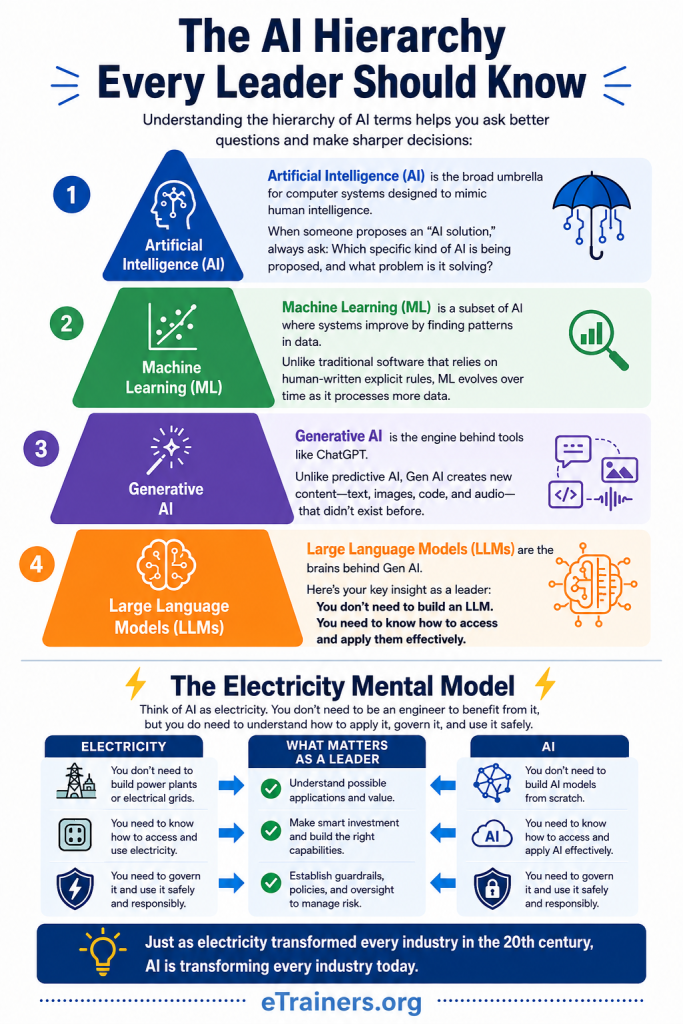
    The AI Hierarchy Every Leader Should Know
    Understanding the hierarchy of AI terms helps you ask better questions and make sharper decisions:

    Download our free AI Resources for Leaders.

    Your Action Item: In your next AI conversation, ask which specific type of AI is being proposed and what business problem it solves. This simple question will immediately elevate the quality of the discussion.

    Home » Assessments
    Do you have AI Training for Leaders?

    Yes! We offer the course only to current clients because we know they have met organizational readiness.

  • What CLOs Should Look for in Assessment Partners

    What CLOs Should Look for in Assessment Partners

    Why Every Leader Needs a Fuller Picture

    Have you ever wondered how your team truly experiences your leadership? Most of us have a sense of our own strengths and weaknesses, but our self-perception rarely tells the whole story. That’s where 360-degree feedback comes in — and tools like Leader Lens 360 from eTrainers.org make it easier, faster, and more insightful than ever.

    What Is 360 Feedback?

    360 feedback is a leadership development process that gathers input from multiple perspectives — your manager, peers, direct reports, and even clients — and compares that feedback to your own self-assessment. Instead of relying on a single point of view, you get a well-rounded, panoramic view of how your leadership shows up in the real world.

    The name says it all: 360 degrees. No blind spots. No echo chambers. Just honest, actionable insight.

    The Key Benefits of 360 Feedback

    1. Identify Your Blind Spots

    One of the most powerful aspects of 360 feedback is its ability to surface what you simply cannot see on your own. Leader Lens 360 is designed to help leaders “identify blind spots and align perceptions” — because what you think you’re doing and what others experience can be very different.

    When a manager believes they communicate clearly, but their team feels left in the dark, that gap becomes a leadership liability. 360 feedback bridges that gap.

    2. Gain Multi-Dimensional Insight Across Key Competencies

    Leader Lens 360 evaluates leaders across 10 critical leadership competency areas, including:

    • Leadership & Influence — Are you inspiring confidence in your direction?
    • Communication & Feedback — Are your messages landing the way you intend?
    • Coaching & Development — Are you helping others grow?
    • Emotional Intelligence — How well do you manage yourself under pressure?
    • Accountability & Ownership — Do you follow through on your commitments?
    • Change & Adaptability — Can you navigate and lead through transitions?
    • Conflict Resolution — Do you address conflict constructively?
    • Inclusion & Collaboration — Are you leveraging diverse perspectives?
    • Team Effectiveness — Are you contributing to a positive team culture?
    • Strategic Thinking — Are you making decisions with the bigger picture in mind?

    By measuring feedback across all of these areas, leaders get a comprehensive snapshot of their effectiveness — not just in one dimension, but across everything that matters most.

    3. Compare Self-Perception with Reality

    One of the most eye-opening features of a well-designed 360 tool is the self-vs-others comparison. Leader Lens 360 asks participants to rate themselves honestly across each competency, then compares those ratings with the feedback received from raters.

    This comparison can reveal:

    • Areas where you overestimate your effectiveness
    • Areas where you underestimate yourself (hidden strengths!)
    • Competencies where your self-perception is well-aligned with others — a sign of strong self-awareness

    This kind of insight is invaluable for personal growth and professional development.

    4. Collect Feedback from the People Who Matter Most

    Unlike traditional top-down performance reviews, 360 feedback captures perspectives from everyone in your professional orbit. Leader Lens 360 invites:

    • Your Manager — for a top-down performance perspective
    • Peers or Direct Reports — for a ground-level view of your day-to-day leadership
    • Clients (if applicable) — for an external perspective that many assessments miss entirely

    As the platform notes, “Client feedback is highly recommended and provides a unique external perspective.” This outside-in view often reveals things that internal raters simply cannot see.

    5. Encourages Accountability and Honest Reflection

    Leader Lens 360 doesn’t just ask others for feedback — it also invites leaders to reflect on what they want to START, STOP, and CONTINUE in their leadership practice. This simple but powerful framework encourages:

    • Intentional reflection on current behaviors
    • Personal accountability for growth
    • Concrete action planning rather than vague intentions

    When leaders articulate their own development goals alongside peer feedback, meaningful change becomes far more likely.

    6. Receive a Personalized, AI-Powered Development Report

    What sets Leader Lens 360 apart is its AI-powered analysis that generates a personalized leadership insight and development report. Once feedback is collected, leaders receive a report that highlights:

    • Strengths to be celebrated and leveraged
    • Development opportunities to prioritize
    • A recommended learning path tailored to their results

    This isn’t generic feedback — it’s a customized roadmap for becoming a better leader, delivered straight to your inbox.

    7. It’s Quick, Confidential, and Low-Barrier

    One common reason organizations avoid 360 feedback? They assume it’s too time-consuming or complex. Leader Lens 360 breaks down that barrier entirely. The assessment typically takes just 5–7 minutes to complete, and all rater responses are kept confidential — encouraging honest, candid feedback without fear of professional repercussions.

    This makes it accessible for busy professionals and teams of all sizes.

    Who Should Use 360 Feedback?

    The short answer? Any leader who wants to grow.

    Whether you’re a first-time manager trying to find your footing, a seasoned executive looking to refine your style, or an organization committed to building a stronger leadership culture — 360 feedback offers something for everyone.

    Leader Lens 360 is particularly valuable for:

    • Leaders preparing for new roles or increased responsibility
    • Teams going through change or transformation
    • Organizations investing in leadership development programs
    • Anyone who wants to lead with greater self-awareness and impact

    Final Thoughts

    Leadership doesn’t happen in a vacuum. It’s experienced by the people around you every single day — and their perspective matters.

    360 feedback gives you the gift of honest, multi-source insight so you can stop guessing and start growing. With a tool like Leader Lens 360, you don’t just get data — you get a personalized development experience powered by AI, grounded in the competencies that define effective leadership.

    Ready to see yourself through a clearer lens?

    For a limited time, Try Leader Lens 360 at eTrainers.org and receive your personalized leadership insight report in minutes.

    “Identify blind spots, align perceptions, and receive a personalized learning path in minutes.”
    — eTrainers.org | Leader Lens 360

    © 2026 eTrainers.org | Leader Lens 360 | All rights reserved.

    Home » Assessments
    Are your assessments in Spanish?

    Yes, our assessments are in English and Spanish. Visit our assessment center to learn more.

  • Selling versus Adding Value

    Selling versus Adding Value

    The phrase “I don’t sell, I add value” has become a popular badge of authenticity in today’s business culture. It sounds noble—and in principle, it is. Yet, if we pause for a moment, we have to ask an important question: How do you know what’s truly valuable to someone until you know them?

    Many of us use “adding value” as a catch-all phrase to share tips, give away content, or offer discounts. But here’s the problem: what’s valuable to you isn’t always beneficial to your audience. A motivational quote might inspire one person and mean nothing to another. A time-saving tool might thrill a manager but frustrate a creative who prefers customization over efficiency. When we assume what others value, we slip back into a self-centered mindset disguised as generosity. We may still be “selling”—just wrapped in a different package.

    True Value Begins with a Relationship

    To really add value, we must first establish a relationship. That starts with curiosity. Ask questions. Listen deeply. Learn their challenges, their wins, and the little things that matter most to them. Only then can we tailor input, insight, or support that genuinely improves their situation.


    Want more? Sign up for our free course on Managing Relationships in Sales.


    True value flows through understanding. Without a relationship, “adding value” risks becoming performance—well-intentioned but impersonal.

    Adding value isn’t an event—it’s a process. It grows as trust grows. In a world where content floods inboxes and social feeds, human connection stands out. Whether you’re a leader, coach, or entrepreneur, adding value begins when you stop trying to impress and start trying to understand.

    When you know what matters most to someone, your ideas, products, and solutions naturally align with their world. That alignment creates what every business hopes for: meaningful impact.

    Transaction or Transformation

    Selling focuses on the transaction. Adding value focuses on transformation, but transformation only happens through relationships.

    So the next time someone says, “I don’t sell, I add value,” consider asking: “How do you determine what’s valuable to the person?”

    Home » Assessments