Why Assessments Are Your Secret Weapon Against Workplace Anxiety
Change is hard. We all know this. But here’s what makes it even harder: walking into the unknown without a map.
When organizations introduce new technologies—especially AI—employees often find themselves caught between excitement and fear. Will this tool help me work smarter, or will it replace me entirely? This isn’t paranoia. It’s a legitimate concern shared by 53% of employees who worry about being replaced by emerging technologies.
The good news? There’s a proven way to transform that fear into confidence. It starts with something surprisingly simple: a diagnostic assessment.
The Power of Knowing Where You Stand
Effective change doesn’t begin with training. It begins with understanding.
Think about the last time you learned something new. Whether it was a software platform, a teaching methodology, or a professional skill, the process probably felt overwhelming at first. Now imagine if someone had shown you exactly what you already knew and precisely what you needed to learn. Suddenly, that mountain looks more like a manageable hill.
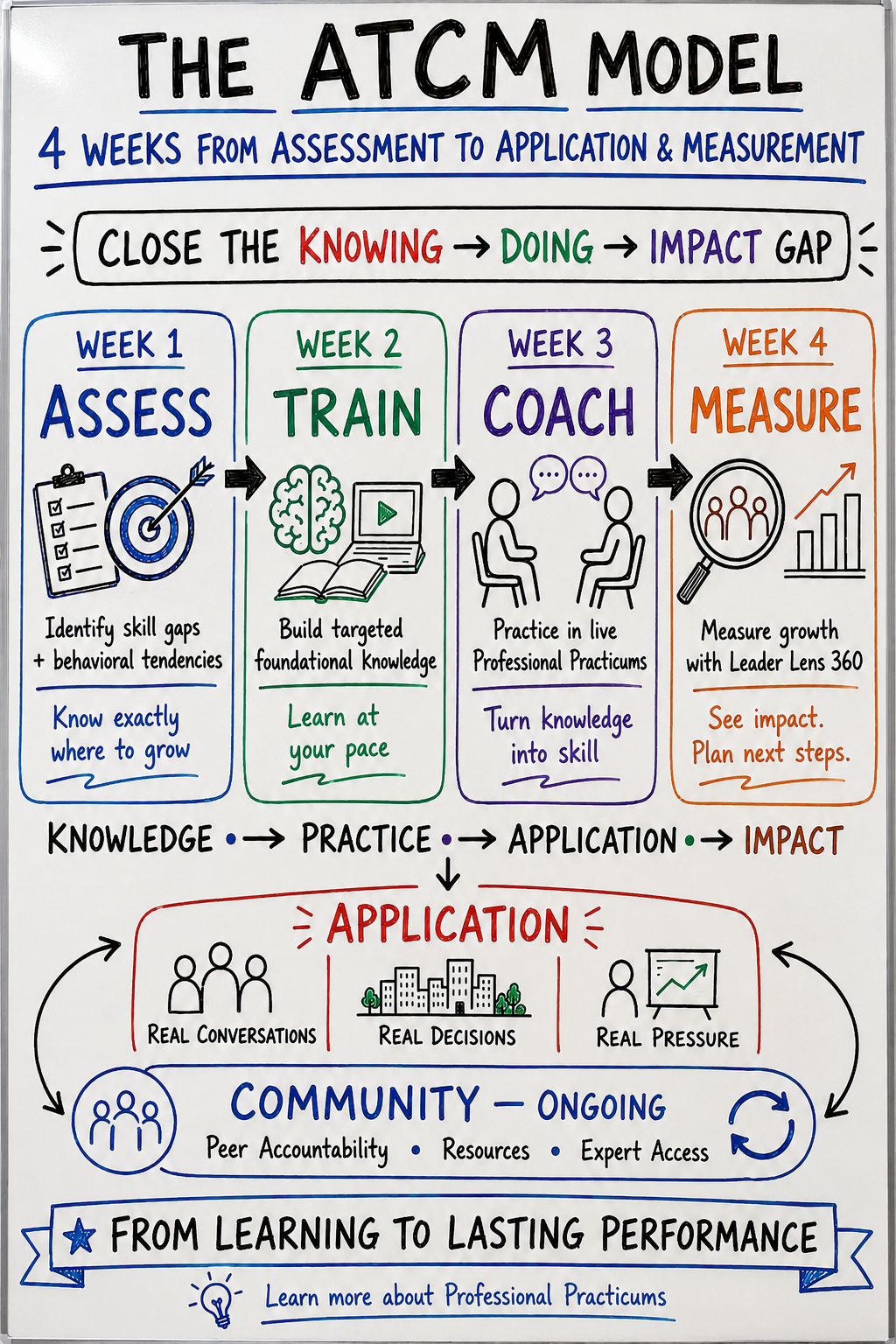
This is the principle behind diagnostic assessments, and it’s why the “Assess” phase of the ATCM (Assess, Train, Coach, Measure) model is so critical. Before anyone opens a training module or attends a workshop, we first need to establish a baseline. What skills do your people already have? Where are the gaps? What specific knowledge will move them from where they are to where they need to be?
Connecting Assessment to Awareness: A Cognitive Bridge
If you’re familiar with the ADKAR model—Awareness, Desire, Knowledge, Ability, Reinforcement—you know that awareness is the essential first step. People need to understand why change is happening before they can embrace it.
Here’s where things get interesting: the “Assess” phase of ATCM acts as the cognitive foundation for ADKAR’s “Awareness” phase.
When employees complete a thoughtful diagnostic assessment, several powerful things happen:
- They see their current capabilities clearly. This isn’t about highlighting weaknesses—it’s about creating an honest picture of their professional landscape.
- They understand what they need to learn. The mystery disappears. Instead of vague anxiety about “learning AI,” they know they need to master three specific skills.
- They recognize the gap is manageable. When the unknown becomes known, fear shrinks. A concrete learning path replaces the terrifying void of uncertainty.
In other words, assessment doesn’t just inform training—it builds psychological safety.
Reducing the Cognitive Load of the Unknown
Let’s talk about cognitive load for a moment.
When employees face organizational change without clear information, their brains work overtime trying to fill in the gaps. What will this mean for my job? How much do I need to learn? Am I capable of this? What if I fail?
This mental energy drain doesn’t just cause stress—it actively impairs learning. People operating from fear and uncertainty have fewer cognitive resources available to actually acquire new skills.
By conducting skill gap assessments upfront, you’re essentially clearing the mental clutter. You’re saying to your team: “Here’s exactly where you are. Here’s exactly where you need to go. And here’s exactly how we’re going to get you there.”
That clarity is liberating. And liberated learners are effective learners.
Addressing the Replacement Fear Head-On
Remember that 53% statistic? More than half of employees fear being replaced by AI and automation. This fear is the elephant in every training room when organizations roll out new technology initiatives.
Diagnostic assessments address this fear in a surprisingly direct way. When you assess employees before training, you’re sending a clear message: we’re investing in developing you, not replacing you.
Think about it from the employee’s perspective:
- If the organization planned to replace them, why bother identifying their skill gaps?
- If they were expendable, why create a personalized learning pathway?
- If their growth didn’t matter, why measure their starting point at all?
Assessment is an act of commitment. It says, “We see you, we value you, and we’re going to help you grow alongside this technology.”
Targeted Training: The Efficiency Advantage
Beyond the psychological benefits, diagnostic assessments deliver a powerful practical advantage: targeted training interventions.
Without assessment, organizations often default to one-size-fits-all training programs. Everyone sits through the same modules, regardless of their existing knowledge. The result? Some employees are bored because they already know the material. Others are overwhelmed because the training assumes knowledge they don’t have. Nearly everyone is disengaged to some degree.
With a proper diagnostic approach:
- Advanced learners can skip foundational content and focus on advanced applications
- Beginners receive the scaffolding they need without feeling rushed
- Everyone spends their learning time on content that actually moves the needle
This isn’t just better for the learner—it’s better for the organization. Targeted training accelerates onboarding velocity, getting employees productive faster while consuming fewer resources.
Preventing the Organizational Plateau
Here’s a pattern we see repeatedly: Organizations launch AI initiatives with great enthusiasm. There’s excitement, investment, and momentum. Then, somewhere around the 60-70% implementation mark, progress stalls.
Welcome to the organizational plateau.
Why does this happen? Often, it’s because the easy adopters have adapted, but the remaining employees—those with greater skill gaps, more fear, or less clarity about expectations—haven’t been equipped for success.
Diagnostic assessments prevent this plateau by ensuring no one gets left behind from the start. When you understand everyone’s baseline, you can design learning pathways that bring your entire team along. You identify who needs extra support before they become bottlenecks. You create success conditions for every learner, not just the quick adopters.
The result is smoother implementation, sustained momentum, and AI projects that actually reach their full potential.
Putting This Into Practice
Ready to build assessment into your change management approach? Here’s how to get started:
1. Design Assessments That Inform, Not Intimidate
Your diagnostic should feel like a helpful tool, not a test that could affect someone’s job security. Frame it as a way to personalize learning, not evaluate performance.
2. Share Results Transparently
When employees complete assessments, give them clear feedback. Show them their strengths, their growth areas, and how their personalized training plan addresses each gap.
3. Connect Assessment to Purpose
Help employees understand why you’re assessing before training. Explain the benefits—more relevant learning, faster skill development, and a clearer path forward.
4. Use Assessment Data to Build Confidence
Celebrate existing competencies, not just gaps. When employees see what they already bring to the table, they approach new learning from a position of strength.
5. Reassess and Celebrate Progress
Follow up with post-training assessments that demonstrate growth. Nothing builds confidence like tangible evidence of advancement.
The Bottom Line
Effective change management isn’t about pushing people through training and hoping for the best. It’s about meeting people where they are, understanding what they need, and creating clear pathways to success.
The “Assess” phase isn’t just a preliminary step—it’s the foundation that makes everything else possible. It turns awareness from a vague understanding that “change is coming” into concrete knowledge: “I know exactly what I need to learn, and I can do this.”
When you reduce the cognitive load of the unknown, you free up mental resources for actual learning. When you address replacement fears through demonstrated investment in development, you build trust. When you target training to real skill gaps, you accelerate results.
And when you do all of this from day one, you set your AI initiatives—and your people—up for genuine, lasting success.
At eTrainers.org, we believe that effective learning starts with understanding. Our diagnostic tools and personalized learning pathways help organizations navigate change while empowering every employee to thrive.
Ready to build your foundation for fearless change? Visit our Competency Assessment Center