Regulatory agencies like OSHA don’t just recommend that employers provide training workers can understand—they require it. OSHA’s guidelines explicitly state that safety training must be presented in a language and vocabulary workers can comprehend.
This means if your Spanish-speaking employees can’t fully understand their compliance training, your organization may be at risk for:
Regulatory citations and fines
Failed audits
Increased liability in the event of workplace incidents
Lower overall compliance rates
Spanish-language compliance courses ensure your team understands critical regulations—whether you’re covering hazard communication, lockout/tagout procedures, or industry-specific standards. When employees truly grasp the “why” behind the rules, compliance becomes second nature, not a checkbox exercise.
Safety Training That Actually Protects Let’s talk about what’s really at stake: people’s well-being.
Frontline workers in manufacturing, warehousing, food processing, and similar industries face real hazards every day. Machinery, chemicals, heavy equipment, repetitive motions—the list goes on. Effective safety training can mean the difference between a worker going home healthy and a preventable injury.
But here’s the thing: safety training only works when workers understand it completely. When instructions about emergency procedures, PPE requirements, or equipment operation are delivered in an unfamiliar language, crucial details can get lost.
Spanish safety training courses address this directly by providing:
Clear explanations of workplace hazards in workers’ native language
Step-by-step procedures they can confidently follow
Visual demonstrations paired with Spanish narration for better retention
Accessible resources workers can reference when questions arise
When your employees fully understand how to protect themselves and their coworkers, everyone benefits—including your organization’s safety record and insurance costs.
Why Spanish-Language Training Courses Matter for Your Workforce
When it comes to workplace safety, compliance, and operational excellence, clear communication isn’t just important—it’s essential. Yet for millions of Spanish-speaking frontline workers across the United States, critical training often arrives in a language that creates barriers rather than bridges.
The solution? Spanish-language training courses designed specifically for the industries and roles where they’re needed most.
The Reality: A Diverse Workforce Deserves Inclusive Training According to the U.S. Bureau of Labor Statistics, Hispanic and Latino workers make up a significant and growing portion of the American workforce—particularly in manufacturing, construction, warehousing, and other frontline industries. Many of these workers are bilingual, while others are more comfortable learning and retaining information in Spanish.
Here’s the challenge: when training materials only exist in English, comprehension gaps can emerge. And in high-stakes environments where compliance violations carry hefty fines and safety lapses can cost lives, those gaps become serious risks.
The bottom line? Offering training in your employees’ preferred language isn’t just a nice gesture—it’s a strategic investment in your organization’s safety, efficiency, and legal standing.
Start with our skill gap analysis (Spanish version).
Sign up to view our Spanish course descriptions and objectives, and schedule your personal tour of our catalog.
And the science-backed model that actually changes behavior
The Uncomfortable Reality L&D Leaders Need to Face
Your organization spent six figures on that learning management system. Your team produced polished video modules. Your completion rates look impressive in quarterly reports.
And yet—nothing has changed on the job.
This isn’t a content problem. It’s an architecture problem. And until we confront it honestly, we’ll keep pouring budget into digital assets that collect dust while performance gaps persist.
Dr. Philippa Hardman’s research delivers an inconvenient truth: traditional video tutorials and quizzes have negligible impact on actual behavior change. The “watch-and-quiz” model that dominates corporate training creates an illusion of learning while failing to produce what matters—skill execution when it counts.
The Knowing-Doing Gap: Where Your Training Budget Goes to Die
Here’s what the science tells us:
Learners forget up to 70% of training content within 24 hours without structured practice
Knowledge recall (passing a quiz) and skill application (performing under pressure) are fundamentally different cognitive processes
Passive consumption—no matter how engaging the video—doesn’t build the neural pathways required for automatic, in-the-moment execution
The result? What I call the “infrastructure tax”—the hidden cost organizations pay when L&D spend fails to convert into job-site execution. You’re not just losing the training budget. You’re losing:
Performance gains that never materialize
Development velocity as teams plateau despite completing courses
Organizational learning as the same mistakes repeat across departments
Most training stops at knowledge transfer—presenting information, assessing recall, and calling it complete. But knowing something and being able to use it in a high-stakes real-world moment are fundamentally different skills.
Why Behavior Change Requires More Than Information
Dr. Hardman’s research points to a critical insight: learning that sticks occurs when information is embedded in a stable, repetitive context that fosters habit formation.
Think about how you actually developed your most reliable professional skills. It wasn’t through watching a video once. It was through:
Repeated practice in realistic conditions
Feedback loops that refined your approach
Social accountability that kept you engaged
Gradual mastery that built genuine confidence
This is the science of learning transfer—the ability to take what you learned in training and actually use it when stakes are high, time is short, and pressure is real.
Applying communication frameworks in the moment—not reciting them from memory in a quiz. Making sound judgment calls under pressure, drawing on practiced mental models—not theory. Navigating conflict, negotiation, and complexity the way it actually happens—messy, fast, and consequential.
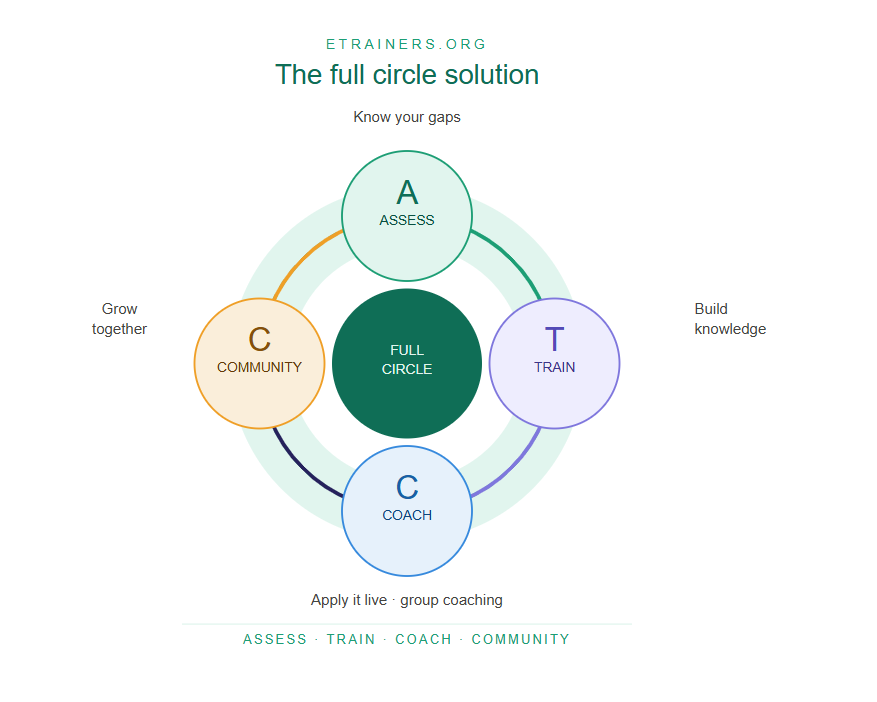
Introducing the ATC Model: Assess → Train → Coach
The solution isn’t to abandon digital learning. It’s to embed it within a complete ecosystem where each phase reinforces the next, and no skill falls through the cracks.
The ATC (Assess – Train – Coach) Model represents a fundamental shift from content delivery to behavior architecture:
Phase 1: Assess
Most training programs assume everyone needs the same thing. The ATC Model starts differently—with a rigorous diagnostic designed to surface exactly where each learner needs to grow.
Rather than assigning generic content, you build a development path that is precise, efficient, and directly tied to real performance gaps. No filler. No wasted time. Just targeted growth where it matters most.
Phase 2: Train
Build foundational knowledge through structured online learning—at your pace, on your schedule. This is where traditional e-learning fits, but only as one component of a larger system, not the entire solution.
Phase 3: Coach
This is where the ATC Model diverges dramatically from conventional training. Professional Practicums—live, group coaching sessions—ensure learners don’t just review what they’ve studied; they immediately apply it.
Through structured role plays, realistic case studies, simulated conversations, and real-world problem solving, participants build the muscle memory that makes skills stick. This isn’t passive consumption. It’s active, guided practice—with peers facing the same challenges under the same pressures.
What gets practiced:
Real negotiation dynamics—finding leverage, managing concessions, reaching agreements under pressure
Simulated interpersonal and team conflicts using frameworks in the heat of realistic scenarios
Complex, ambiguous business challenges with time constraints and competing priorities
Difficult professional conversations—from feedback delivery to executive communication
Sustain: The Learners’ Lounge
Skills built in isolation fade. Skills built in community compound.
The ongoing community component provides peer accountability, continued access to frameworks and facilitated discussions, and engagement with coaches beyond formal sessions—because real growth doesn’t follow a schedule.
The Business Case: Eliminating the Infrastructure Tax
When training converts to execution, the ROI math changes entirely:
Traditional Training
ATC Model
High completion, low application
Targeted development with verified transfer
Generic content for everyone
Precision diagnostics driving personalized paths
One-time event, rapid decay
Sustained practice and community reinforcement
Knowledge measured by quiz scores
Skills measured by job-site behavior
The ATC Model eliminates the infrastructure tax by ensuring every dollar spent on learning development produces measurable change in how people actually perform their jobs—not just what they can recall on a test.
The Architecture Matters More Than the Content
AI can build training. AI can test knowledge. AI can generate content faster than any human team. But knowledge alone has never changed behavior. Learning transfer does.
The gap between knowing and doing is where most training programs fail—and where real ROI is lost. The cost isn’t just wasted budget. It’s missed performance, stalled development, and teams that keep making the same mistakes despite completing required training.
Stop investing in training that stops at knowledge. Start building the skills your teams need to perform—in real conversations, real decisions, and real pressure.
Ready to close the knowing-doing gap in your organization?
The phrase “I don’t sell, I add value” has become a popular badge of authenticity in today’s business culture. It sounds noble—and in principle, it is. Yet, if we pause for a moment, we have to ask an important question: How do you know what’s truly valuable to someone until you know them?
Many of us use “adding value” as a catch-all phrase to share tips, give away content, or offer discounts. But here’s the problem: what’s valuable to you isn’t always beneficial to your audience. A motivational quote might inspire one person and mean nothing to another. A time-saving tool might thrill a manager but frustrate a creative who prefers customization over efficiency. When we assume what others value, we slip back into a self-centered mindset disguised as generosity. We may still be “selling”—just wrapped in a different package.
True Value Begins with a Relationship
To really add value, we must first establish a relationship. That starts with curiosity. Ask questions. Listen deeply. Learn their challenges, their wins, and the little things that matter most to them. Only then can we tailor input, insight, or support that genuinely improves their situation.
True value flows through understanding. Without a relationship, “adding value” risks becoming performance—well-intentioned but impersonal.
Adding value isn’t an event—it’s a process. It grows as trust grows. In a world where content floods inboxes and social feeds, human connection stands out. Whether you’re a leader, coach, or entrepreneur, adding value begins when you stop trying to impress and start trying to understand.
When you know what matters most to someone, your ideas, products, and solutions naturally align with their world. That alignment creates what every business hopes for: meaningful impact.
Transaction or Transformation
Selling focuses on the transaction. Adding value focuses on transformation, but transformation only happens through relationships.
So the next time someone says, “I don’t sell, I add value,” consider asking: “How do you determine what’s valuable to the person?”