Tag: john maxwell

  • AI for Leaders

    Speak the Language, Make Sharper Decisions

    Artificial intelligence isn’t just a technical project—it’s a leadership imperative. Yet many executives feel lost in a sea of jargon, unable to distinguish buzzwords from business-critical concepts. If you want to lead confidently in the age of AI, you first need to speak the language.

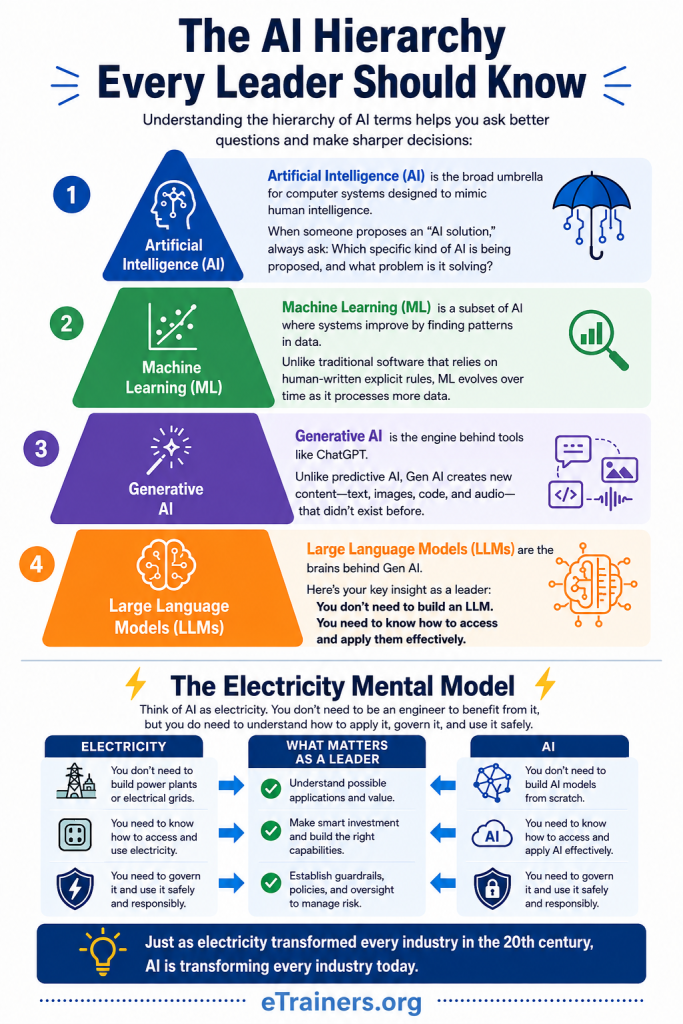
    The AI Hierarchy Every Leader Should Know
    Understanding the hierarchy of AI terms helps you ask better questions and make sharper decisions:

    Your Action Item: In your next AI conversation, ask which specific type of AI is being proposed and what business problem it solves. This simple question will immediately elevate the quality of the discussion.

  • The Power of 360 Feedback

    The Power of 360 Feedback

    Why Every Leader Needs a Fuller Picture

    Have you ever wondered how your team truly experiences your leadership? Most of us have a sense of our own strengths and weaknesses, but our self-perception rarely tells the whole story. That’s where 360-degree feedback comes in — and tools like Leader Lens 360 from eTrainers.org make it easier, faster, and more insightful than ever.

    What Is 360 Feedback?

    360 feedback is a leadership development process that gathers input from multiple perspectives — your manager, peers, direct reports, and even clients — and compares that feedback to your own self-assessment. Instead of relying on a single point of view, you get a well-rounded, panoramic view of how your leadership shows up in the real world.

    The name says it all: 360 degrees. No blind spots. No echo chambers. Just honest, actionable insight.

    The Key Benefits of 360 Feedback

    1. Identify Your Blind Spots

    One of the most powerful aspects of 360 feedback is its ability to surface what you simply cannot see on your own. Leader Lens 360 is designed to help leaders “identify blind spots and align perceptions” — because what you think you’re doing and what others experience can be very different.

    When a manager believes they communicate clearly, but their team feels left in the dark, that gap becomes a leadership liability. 360 feedback bridges that gap.

    2. Gain Multi-Dimensional Insight Across Key Competencies

    Leader Lens 360 evaluates leaders across 10 critical leadership competency areas, including:

    • Leadership & Influence — Are you inspiring confidence in your direction?
    • Communication & Feedback — Are your messages landing the way you intend?
    • Coaching & Development — Are you helping others grow?
    • Emotional Intelligence — How well do you manage yourself under pressure?
    • Accountability & Ownership — Do you follow through on your commitments?
    • Change & Adaptability — Can you navigate and lead through transitions?
    • Conflict Resolution — Do you address conflict constructively?
    • Inclusion & Collaboration — Are you leveraging diverse perspectives?
    • Team Effectiveness — Are you contributing to a positive team culture?
    • Strategic Thinking — Are you making decisions with the bigger picture in mind?

    By measuring feedback across all of these areas, leaders get a comprehensive snapshot of their effectiveness — not just in one dimension, but across everything that matters most.

    3. Compare Self-Perception with Reality

    One of the most eye-opening features of a well-designed 360 tool is the self-vs-others comparison. Leader Lens 360 asks participants to rate themselves honestly across each competency, then compares those ratings with the feedback received from raters.

    This comparison can reveal:

    • Areas where you overestimate your effectiveness
    • Areas where you underestimate yourself (hidden strengths!)
    • Competencies where your self-perception is well-aligned with others — a sign of strong self-awareness

    This kind of insight is invaluable for personal growth and professional development.

    4. Collect Feedback from the People Who Matter Most

    Unlike traditional top-down performance reviews, 360 feedback captures perspectives from everyone in your professional orbit. Leader Lens 360 invites:

    • Your Manager — for a top-down performance perspective
    • Peers or Direct Reports — for a ground-level view of your day-to-day leadership
    • Clients (if applicable) — for an external perspective that many assessments miss entirely

    As the platform notes, “Client feedback is highly recommended and provides a unique external perspective.” This outside-in view often reveals things that internal raters simply cannot see.

    5. Encourages Accountability and Honest Reflection

    Leader Lens 360 doesn’t just ask others for feedback — it also invites leaders to reflect on what they want to START, STOP, and CONTINUE in their leadership practice. This simple but powerful framework encourages:

    • Intentional reflection on current behaviors
    • Personal accountability for growth
    • Concrete action planning rather than vague intentions

    When leaders articulate their own development goals alongside peer feedback, meaningful change becomes far more likely.

    6. Receive a Personalized, AI-Powered Development Report

    What sets Leader Lens 360 apart is its AI-powered analysis that generates a personalized leadership insight and development report. Once feedback is collected, leaders receive a report that highlights:

    • Strengths to be celebrated and leveraged
    • Development opportunities to prioritize
    • A recommended learning path tailored to their results

    This isn’t generic feedback — it’s a customized roadmap for becoming a better leader, delivered straight to your inbox.

    7. It’s Quick, Confidential, and Low-Barrier

    One common reason organizations avoid 360 feedback? They assume it’s too time-consuming or complex. Leader Lens 360 breaks down that barrier entirely. The assessment typically takes just 5–7 minutes to complete, and all rater responses are kept confidential — encouraging honest, candid feedback without fear of professional repercussions.

    This makes it accessible for busy professionals and teams of all sizes.

    Who Should Use 360 Feedback?

    The short answer? Any leader who wants to grow.

    Whether you’re a first-time manager trying to find your footing, a seasoned executive looking to refine your style, or an organization committed to building a stronger leadership culture — 360 feedback offers something for everyone.

    Leader Lens 360 is particularly valuable for:

    • Leaders preparing for new roles or increased responsibility
    • Teams going through change or transformation
    • Organizations investing in leadership development programs
    • Anyone who wants to lead with greater self-awareness and impact

    Final Thoughts

    Leadership doesn’t happen in a vacuum. It’s experienced by the people around you every single day — and their perspective matters.

    360 feedback gives you the gift of honest, multi-source insight so you can stop guessing and start growing. With a tool like Leader Lens 360, you don’t just get data — you get a personalized development experience powered by AI, grounded in the competencies that define effective leadership.

    Ready to see yourself through a clearer lens?

    For a limited time, Try Leader Lens 360 at eTrainers.org and receive your personalized leadership insight report in minutes.

    “Identify blind spots, align perceptions, and receive a personalized learning path in minutes.”
    — eTrainers.org | Leader Lens 360

    © 2026 eTrainers.org | Leader Lens 360 | All rights reserved.

  • Fostering Relationships while Maintaining Productivity

    Fostering Relationships while Maintaining Productivity

    One of the constant challenges leaders face is building relationships while staying on top of other daily demands. It’s a delicate balance because both are equally important, yet achieving both often feels like walking on a tightrope.

    In the early days of my leadership journey, I erred on the side of productivity. As an emerging leader, I was too focused on the numbers, which made my leaders happy but not my direct reports. It took several years for me to balance people and productivity.

    How to prioritize your most important asset – people:

    • Keeping scheduled one-on-one meetings
    • Utilizing one-on-ones to get to know the person–not the professional
    • Sharing more about my personal life
    • Maintaining a DRM (direct report management)

    Like CRM, DRM systems helped me improve relationships. I noted what was important to them and was intentional about asking questions during our meetings. 

    The four commitments enabled me to achieve the balance that I needed, and the bonus was that productivity increased. I was managing a contact center, and our overall scores improved in call duration and customer satisfaction. 

    Prioritizing People IMPROVED Productivity!

    Want more? Sign up for a free trial to our Managing Relationships and Productivity course.

  • Proven AI Literacy for Leaders: What Models Miss

    Proven AI Literacy for Leaders: What Models Miss


    The most important resource in any organization isn’t technology. It’s you.

    We are living in an extraordinary moment.

    AI is reshaping industries, redefining workflows, and revolutionizing how we process information.

    Smart leaders pay attention to that.

    Literacy isn’t optional anymore.

    Understanding how these tools work is essential. They show what they can do and where they fit into your organization.

    That is part of leading well in the 21st century.

    However, here’s what I need you to understand. AI is central to this.

    AI literacy isn’t just about learning the technology.

    It’s about remembering your humanity.

    Moreover, for everything AI can do, there is a vast, irreplaceable leadership territory that belongs to you. Leaders who thrive now won’t be the ones who simply use technology best. They’ll be the ones who understand what technology cannot touch.

    Let’s talk about what that looks like.


    1. AI Can Process Information. Only You Can Build Trust.

    A machine can analyze a thousand data points in seconds.

    AI complements this ability by identifying patterns, generating reports, and predicting trends with accuracy.

    However, a machine has never looked someone in the eye during their worst moment.

    It has never said, ‘I believe in you. We’re going to get through this together’.

    Trust isn’t built through efficiency.

    Trust is built through presence, consistency, and genuine care.

    It’s built in hallway conversations.

    The difficult feedback delivered with love matters.

    Moments when you choose your people over your convenience define trust.

    People don’t follow algorithms. People follow leaders they trust. And trust is currency that only humans can earn.

    As a leader, your invitation is this: don’t let technology speed up at the expense of relationships. Moreover, AI-driven change makes your willingness to slow down and connect one of your greatest competitive advantages.


    2. AI Can Generate Ideas. Only You Can Cast a Vision.

    I’ve seen AI produce impressive content — strategies, plans, even creative concepts. But there’s a profound difference between generating ideas and casting a vision that moves people to sacrifice for something greater than themselves.

    Vision isn’t a product of computation. It’s born in the soul of a leader who has wrestled with purpose, asked hard questions in quiet moments, and emerged with a burning conviction about what could be.

    When Martin Luther King Jr. stood before a nation and said, “I have a dream,” he wasn’t reciting data.

    He issued an invitation. It invited steps into a future that didn’t yet exist, fueled by hope and shared humanity.

    No machine could have written that moment.

    That moment required a man who had suffered and struggled, and who believed enough to stand.

    In an era of AI, human courage remains essential.

    Your vision carries weight because you carry weight. Your story, your scars, your convictions — these are the ingredients of vision that actually move people. AI can give you information. Only you can give your team inspiration.


    3. AI Can Identify a Problem. Only You Can Exercise Moral Courage.

    Here’s a leadership truth that has never changed and never will: doing the right thing is rarely the easy thing.

    AI can flag an ethical concern. It can present options. It can even recommend a course of action based on programmed values. But AI cannot choose to do what is right when doing what is right costs something. It cannot feel the weight of a difficult decision. It cannot carry the responsibility of leading people through an ethical crisis with both firmness and grace.

    Moral courage — the willingness to stand for what is right even when it’s uncomfortable, unpopular, or costly — is one of the defining marks of great leadership. And it is entirely, exclusively human.

    The world doesn’t need more leaders who know the right answer. The world needs leaders who have the courage to act on the right answer. That’s your territory. Own it.


    4. AI Can Optimize Performance. Only You Can Develop People.

    I have spent decades studying leadership, and I am more convinced today than ever before: the greatest thing a leader can do is grow another leader.

    AI can track performance metrics. It can identify skill gaps and recommend training programs. It can personalize learning pathways with impressive precision. But it cannot sit across from a young leader who is doubting themselves and see in them what they cannot yet see in themselves. It cannot invest in someone not because of what they produce, but because of who they are.

    People development is an act of love. It requires patience, discernment, and an unwavering belief in human potential. It requires you to notice the quiet person in the room, ask the question nobody else thought to ask, and say “I see something in you”—and mean it.

    Your greatest legacy will never be measured in revenue generated or problems solved. It will be measured in the leaders you raised up who went on to change the world in ways you’ll never fully know. AI can never leave that kind of legacy. But you can.


    5. AI Can Respond. Only You Can Empathize.

    Empathy is not a soft skill. It is a leadership superpower — and it is one that AI can only simulate, never possess.

    When someone on your team loses a parent, faces a health crisis, or shows up carrying a weight you can’t see — what they need isn’t a perfectly crafted response generated in milliseconds. What they need is a leader who is fully present, who genuinely feels the gravity of the moment, and who responds not from a script, but from the heart.

    Empathy changes people. It says, “You are not just a resource to be managed. You are a human being who matters.” And when people feel that — truly feel it — they don’t just work for you. They believe in what you’re building together.

    In a world increasingly mediated by screens and automated responses, your empathy is revolutionary. Don’t minimize it. Develop it. Lean into it. It may be the most distinctly human — and distinctly powerful — thing you bring to your leadership every single day.


    So What Does This Mean for You?

    AI literacy for leaders isn’t a warning — it’s an invitation. An invitation to get clear on what makes you irreplaceable.

    Yes, learn the tools. Understand how AI works. Use it to free up your time, sharpen your thinking, and scale your impact. Absolutely. That’s wisdom.

    But never — never — outsource the things that only you can give:

    • Your trust-building presence
    • Your vision-casting conviction
    • Your moral courage
    • Your investment in people
    • Your empathy

    These are not things a machine will ever replicate. These are the marks of a leader who understands that technology is a tool, but people are the point.


    Here’s the truth I want to leave with you today: The rise of AI is not a threat to great leadership. It is a clarion call to it.

    The world doesn’t need leaders who can keep up with machines. The world needs leaders who are more human than ever — more present, more courageous, more connected to purpose, and more committed to the people in their care.

    That’s your moment. And I believe that you are ready for it.

    Leadership is not about being the smartest person in the room. It’s about bringing out the best in every person in the room — and that is something no machine will ever do better than you.

    Download our free AI Resources for Leaders.

  • Leading Remote Teams

    Leading Remote Teams

    I have been working remotely for two decades, leading teams for half of that time, and fostering engagement has always remained top of mind. 

    Working solo provides excellent opportunities for fast execution; however, team feedback gives us a chance to improve the deliverable because others can see our blind spots. Once, while leading a global training project, a team member saw a huge gap that I had been too close to see. I spent three weeks coordinating training times across three time zones and felt accomplished once each region had a schedule that accommodated its time zone. When I shared the schedule with the team, one of them quickly noticed that our dates would fall during the daylight saving time change and throw the schedule off by an hour — too early for one region and too late for another. Pouring over the schedule was like putting together a 100-piece puzzle, so I didn’t look forward to reworking it. However, if the time wasn’t conducive, it would be worse, so I was grateful for this catch.

    Here are some tips that I’ve used to enable remote teams to effectively work together:

    • Host social activities such as birthday celebrations, holiday parties, and project celebrations. Include a $ 25-per-member lunch stipend in the budget. 
    • Schedule meetings in advance and request that everyone be on camera to foster a more human connection.
    • Create shared spaces for non-project work. For example, use chat rooms for discussing current events or hot topics. 
    • Celebrate successes regularly…even if just to commend everyone for staying on schedule and/or within budget.

    Engagement and collaboration are essential for any successful team, regardless of whether they are working in the same office or across the globe. When team members are engaged, they are more likely to be productive, creative, and motivated because collaboration is essential for innovation and problem-solving.


    Want more? Sign up for our free course on Managing Remote Teams.


  • Selling versus Adding Value

    Selling versus Adding Value

    The phrase “I don’t sell, I add value” has become a popular badge of authenticity in today’s business culture. It sounds noble—and in principle, it is. Yet, if we pause for a moment, we have to ask an important question: How do you know what’s truly valuable to someone until you know them?

    Many of us use “adding value” as a catch-all phrase to share tips, give away content, or offer discounts. But here’s the problem: what’s valuable to you isn’t always beneficial to your audience. A motivational quote might inspire one person and mean nothing to another. A time-saving tool might thrill a manager but frustrate a creative who prefers customization over efficiency. When we assume what others value, we slip back into a self-centered mindset disguised as generosity. We may still be “selling”—just wrapped in a different package.

    True Value Begins with a Relationship

    To really add value, we must first establish a relationship. That starts with curiosity. Ask questions. Listen deeply. Learn their challenges, their wins, and the little things that matter most to them. Only then can we tailor input, insight, or support that genuinely improves their situation.


    Want more? Sign up for our free course on Managing Relationships in Sales.


    True value flows through understanding. Without a relationship, “adding value” risks becoming performance—well-intentioned but impersonal.

    Adding value isn’t an event—it’s a process. It grows as trust grows. In a world where content floods inboxes and social feeds, human connection stands out. Whether you’re a leader, coach, or entrepreneur, adding value begins when you stop trying to impress and start trying to understand.

    When you know what matters most to someone, your ideas, products, and solutions naturally align with their world. That alignment creates what every business hopes for: meaningful impact.

    Transaction or Transformation

    Selling focuses on the transaction. Adding value focuses on transformation, but transformation only happens through relationships.

    So the next time someone says, “I don’t sell, I add value,” consider asking: “How do you determine what’s valuable to the person?”