Tag: leadership

  • Self-Leadership

    Self-Leadership

    The Hardest Person You’ll Ever Lead

    You’ve led teams. You’ve managed processes. Maybe you’ve even coordinated across time zones with global colleagues worldwide.

    But here’s a question worth sitting with: Who is the hardest person you’ve ever had to lead?

    If you’re being honest with yourself, the answer might surprise you.

    It’s not the team member who pushes back on every decision. It’s not the colleague who misses deadlines. It’s not even the stakeholder who keeps changing priorities.

    The hardest person you’ll ever lead is yourself.

    Why Self-Leadership Is Hardest
    I’ve spent years leading people, processes, and places—including global teams across multiple continents. And if I had to rank them by difficulty, leading people would be at the top. But within that category, there’s one person who has challenged me more than anyone else: me.

    Here’s what I’ve learned: Before you can authentically guide others, you must first travel the road yourself. Whatever behavior you want from your teams, you must first live it.

    That’s not always easy. But it’s the benchmark I’ve set for myself—and it’s what separates leaders who inspire from leaders who simply instruct.

    Self-Leadership is a Lifelong Journey
    I haven’t always led myself well. Let me be real with you about that.

    Early in my leadership journey, I was big on winning by “proving my point.” Like a lawyer in a courtroom, I presented fact after fact to establish my case. I built arguments. I defended positions. And often, I won.

    But I won at the expense of something far more valuable: relationships.

    I was so focused on being right that I forgot to consider what was wise.


    Today, I lead differently. The goal is no longer to prove a point—it’s to prioritize the relationship.

    When conflict arises, I ask myself:

    How can WE grow through this experience?
    What, specifically, can I say or do that will create a win-win?
    Because ultimately, a healthier relationship IS the win.

    This shift didn’t happen overnight. It came through reflection, through failure, through choosing humility over pride—again and again. Self-leadership is a growth process. It requires you to look in the mirror and be honest about what you see.

    A Poem Worth Remembering
    When I think about the commitment self-leadership requires, I often reflect on Mother Teresa’s poem, “Do It Anyway.” If you haven’t read it, I encourage you to look it up. Here’s the essence:

    People are often unreasonable, illogical, and self-centered;
    Forgive them anyway.

    If you are kind, people may accuse you of selfish, ulterior motives;
    Be kind anyway.

    If you are successful, you will win some false friends and some true enemies;
    Succeed anyway.

    If you are honest and frank, people may cheat you;
    Be honest and frank anyway.

    What you spend years building, someone could destroy overnight;
    Build anyway.

    If you find serenity and happiness, they may be jealous;
    Be happy anyway.

    The good you do today, people will often forget tomorrow;
    Do good anyway.

    Give the world the best you have, and it may never be enough;
    Give the world the best you’ve got anyway.

    You see, in the final analysis, it is between you and God;
    It was never between you and them anyway.

    That’s self-leadership. Doing what’s right, what’s wise, what’s loving—even when no one notices. Even when it’s hard. Even when you’d rather prove your point.

    Your Invitation This Week
    Here’s my challenge for you: This week, pay attention to the moments when you’re tempted to win the argument instead of win the relationship.

    Ask yourself:

    What would it look like to prioritize connection over correction?
    How can I lead myself through this situation in a way I’d be proud of?
    Self-leadership isn’t about perfection. It’s about progress. It’s about being the kind of leader you’d want to follow.

    And you’re worth following.

    If you’re looking to go deeper on this journey, I invite you to explore our Self-Leadership course in the Learning Solutions Library. It’s a practical resource designed to help you take the next step.

    Home » leadership
    Is Self-Leadership offered online or onsite?

    Both–it is offered as self-study and for groups of 12 or more. Email admin@etrainers.org for more information.

  • Assessment Center Services for Workforce Skills

    Assessment Center Services for Workforce Skills

    Why Assessments Are Your Secret Weapon Against Workplace Anxiety


    Change is hard. We all know this. But here’s what makes it even harder: walking into the unknown without a map.

    When organizations introduce new technologies—especially AI—employees often find themselves caught between excitement and fear. Will this tool help me work smarter, or will it replace me entirely? This isn’t paranoia. It’s a legitimate concern shared by 53% of employees who worry about being replaced by emerging technologies.

    The good news? There’s a proven way to transform that fear into confidence. It starts with something surprisingly simple: a diagnostic assessment.


    The Power of Knowing Where You Stand

    Effective change doesn’t begin with training. It begins with understanding.

    Think about the last time you learned something new. Whether it was a software platform, a teaching methodology, or a professional skill, the process probably felt overwhelming at first. Now imagine if someone had shown you exactly what you already knew and precisely what you needed to learn. Suddenly, that mountain looks more like a manageable hill.

    This is the principle behind diagnostic assessments, and it’s why the “Assess” phase of the ATCM (Assess, Train, Coach, Measure) model is so critical. Before anyone opens a training module or attends a workshop, we first need to establish a baseline. What skills do your people already have? Where are the gaps? What specific knowledge will move them from where they are to where they need to be?


    Connecting Assessment to Awareness: A Cognitive Bridge

    If you’re familiar with the ADKAR model—Awareness, Desire, Knowledge, Ability, Reinforcement—you know that awareness is the essential first step. People need to understand why change is happening before they can embrace it.

    Here’s where things get interesting: the “Assess” phase of ATCM acts as the cognitive foundation for ADKAR’s “Awareness” phase.

    When employees complete a thoughtful diagnostic assessment, several powerful things happen:

    1. They see their current capabilities clearly. This isn’t about highlighting weaknesses—it’s about creating an honest picture of their professional landscape.
    2. They understand what they need to learn. The mystery disappears. Instead of vague anxiety about “learning AI,” they know they need to master three specific skills.
    3. They recognize the gap is manageable. When the unknown becomes known, fear shrinks. A concrete learning path replaces the terrifying void of uncertainty.

    In other words, assessment doesn’t just inform training—it builds psychological safety.


    Reducing the Cognitive Load of the Unknown

    Let’s talk about cognitive load for a moment.

    When employees face organizational change without clear information, their brains work overtime trying to fill in the gaps. What will this mean for my job? How much do I need to learn? Am I capable of this? What if I fail?

    This mental energy drain doesn’t just cause stress—it actively impairs learning. People operating from fear and uncertainty have fewer cognitive resources available to actually acquire new skills.

    By conducting skill gap assessments upfront, you’re essentially clearing the mental clutter. You’re saying to your team: “Here’s exactly where you are. Here’s exactly where you need to go. And here’s exactly how we’re going to get you there.”

    That clarity is liberating. And liberated learners are effective learners.


    Addressing the Replacement Fear Head-On

    Remember that 53% statistic? More than half of employees fear being replaced by AI and automation. This fear is the elephant in every training room when organizations roll out new technology initiatives.

    Diagnostic assessments address this fear in a surprisingly direct way. When you assess employees before training, you’re sending a clear message: we’re investing in developing you, not replacing you.

    Think about it from the employee’s perspective:

    • If the organization planned to replace them, why bother identifying their skill gaps?
    • If they were expendable, why create a personalized learning pathway?
    • If their growth didn’t matter, why measure their starting point at all?

    Assessment is an act of commitment. It says, “We see you, we value you, and we’re going to help you grow alongside this technology.”


    Targeted Training: The Efficiency Advantage

    Beyond the psychological benefits, diagnostic assessments deliver a powerful practical advantage: targeted training interventions.

    Without assessment, organizations often default to one-size-fits-all training programs. Everyone sits through the same modules, regardless of their existing knowledge. The result? Some employees are bored because they already know the material. Others are overwhelmed because the training assumes knowledge they don’t have. Nearly everyone is disengaged to some degree.

    With a proper diagnostic approach:

    • Advanced learners can skip foundational content and focus on advanced applications
    • Beginners receive the scaffolding they need without feeling rushed
    • Everyone spends their learning time on content that actually moves the needle

    This isn’t just better for the learner—it’s better for the organization. Targeted training accelerates onboarding velocity, getting employees productive faster while consuming fewer resources.


    Preventing the Organizational Plateau

    Here’s a pattern we see repeatedly: Organizations launch AI initiatives with great enthusiasm. There’s excitement, investment, and momentum. Then, somewhere around the 60-70% implementation mark, progress stalls.

    Welcome to the organizational plateau.

    Why does this happen? Often, it’s because the easy adopters have adapted, but the remaining employees—those with greater skill gaps, more fear, or less clarity about expectations—haven’t been equipped for success.

    Diagnostic assessments prevent this plateau by ensuring no one gets left behind from the start. When you understand everyone’s baseline, you can design learning pathways that bring your entire team along. You identify who needs extra support before they become bottlenecks. You create success conditions for every learner, not just the quick adopters.

    The result is smoother implementation, sustained momentum, and AI projects that actually reach their full potential.


    Putting This Into Practice

    Ready to build assessment into your change management approach? Here’s how to get started:

    1. Design Assessments That Inform, Not Intimidate

    Your diagnostic should feel like a helpful tool, not a test that could affect someone’s job security. Frame it as a way to personalize learning, not evaluate performance.

    2. Share Results Transparently

    When employees complete assessments, give them clear feedback. Show them their strengths, their growth areas, and how their personalized training plan addresses each gap.

    3. Connect Assessment to Purpose

    Help employees understand why you’re assessing before training. Explain the benefits—more relevant learning, faster skill development, and a clearer path forward.

    4. Use Assessment Data to Build Confidence

    Celebrate existing competencies, not just gaps. When employees see what they already bring to the table, they approach new learning from a position of strength.

    5. Reassess and Celebrate Progress

    Follow up with post-training assessments that demonstrate growth. Nothing builds confidence like tangible evidence of advancement.


    The Bottom Line

    Effective change management isn’t about pushing people through training and hoping for the best. It’s about meeting people where they are, understanding what they need, and creating clear pathways to success.

    The “Assess” phase isn’t just a preliminary step—it’s the foundation that makes everything else possible. It turns awareness from a vague understanding that “change is coming” into concrete knowledge: “I know exactly what I need to learn, and I can do this.”

    When you reduce the cognitive load of the unknown, you free up mental resources for actual learning. When you address replacement fears through demonstrated investment in development, you build trust. When you target training to real skill gaps, you accelerate results.

    And when you do all of this from day one, you set your AI initiatives—and your people—up for genuine, lasting success.


    At eTrainers.org, we believe that effective learning starts with understanding. Our diagnostic tools and personalized learning pathways help organizations navigate change while empowering every employee to thrive.

    Ready to build your foundation for fearless change? Visit our Competency Assessment Center

  • AI for Leaders

    Speak the Language, Make Sharper Decisions

    Artificial intelligence isn’t just a technical project—it’s a leadership imperative. Yet many executives feel lost in a sea of jargon, unable to distinguish buzzwords from business-critical concepts. If you want to lead confidently in the age of AI, you first need to speak the language.

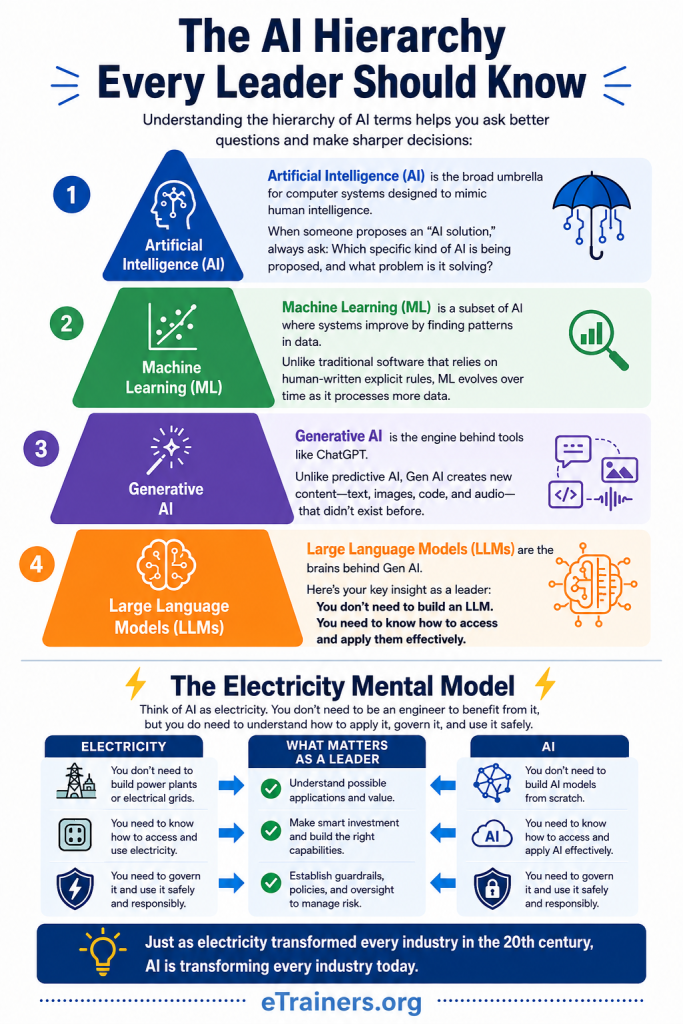
    The AI Hierarchy Every Leader Should Know
    Understanding the hierarchy of AI terms helps you ask better questions and make sharper decisions:

    Download our free AI Resources for Leaders.

    Your Action Item: In your next AI conversation, ask which specific type of AI is being proposed and what business problem it solves. This simple question will immediately elevate the quality of the discussion.

    Home » leadership
    Do you have AI Training for Leaders?

    Yes! We offer the course only to current clients because we know they have met organizational readiness.

  • What CLOs Should Look for in Assessment Partners

    What CLOs Should Look for in Assessment Partners

    Why Every Leader Needs a Fuller Picture

    Have you ever wondered how your team truly experiences your leadership? Most of us have a sense of our own strengths and weaknesses, but our self-perception rarely tells the whole story. That’s where 360-degree feedback comes in — and tools like Leader Lens 360 from eTrainers.org make it easier, faster, and more insightful than ever.

    What Is 360 Feedback?

    360 feedback is a leadership development process that gathers input from multiple perspectives — your manager, peers, direct reports, and even clients — and compares that feedback to your own self-assessment. Instead of relying on a single point of view, you get a well-rounded, panoramic view of how your leadership shows up in the real world.

    The name says it all: 360 degrees. No blind spots. No echo chambers. Just honest, actionable insight.

    The Key Benefits of 360 Feedback

    1. Identify Your Blind Spots

    One of the most powerful aspects of 360 feedback is its ability to surface what you simply cannot see on your own. Leader Lens 360 is designed to help leaders “identify blind spots and align perceptions” — because what you think you’re doing and what others experience can be very different.

    When a manager believes they communicate clearly, but their team feels left in the dark, that gap becomes a leadership liability. 360 feedback bridges that gap.

    2. Gain Multi-Dimensional Insight Across Key Competencies

    Leader Lens 360 evaluates leaders across 10 critical leadership competency areas, including:

    • Leadership & Influence — Are you inspiring confidence in your direction?
    • Communication & Feedback — Are your messages landing the way you intend?
    • Coaching & Development — Are you helping others grow?
    • Emotional Intelligence — How well do you manage yourself under pressure?
    • Accountability & Ownership — Do you follow through on your commitments?
    • Change & Adaptability — Can you navigate and lead through transitions?
    • Conflict Resolution — Do you address conflict constructively?
    • Inclusion & Collaboration — Are you leveraging diverse perspectives?
    • Team Effectiveness — Are you contributing to a positive team culture?
    • Strategic Thinking — Are you making decisions with the bigger picture in mind?

    By measuring feedback across all of these areas, leaders get a comprehensive snapshot of their effectiveness — not just in one dimension, but across everything that matters most.

    3. Compare Self-Perception with Reality

    One of the most eye-opening features of a well-designed 360 tool is the self-vs-others comparison. Leader Lens 360 asks participants to rate themselves honestly across each competency, then compares those ratings with the feedback received from raters.

    This comparison can reveal:

    • Areas where you overestimate your effectiveness
    • Areas where you underestimate yourself (hidden strengths!)
    • Competencies where your self-perception is well-aligned with others — a sign of strong self-awareness

    This kind of insight is invaluable for personal growth and professional development.

    4. Collect Feedback from the People Who Matter Most

    Unlike traditional top-down performance reviews, 360 feedback captures perspectives from everyone in your professional orbit. Leader Lens 360 invites:

    • Your Manager — for a top-down performance perspective
    • Peers or Direct Reports — for a ground-level view of your day-to-day leadership
    • Clients (if applicable) — for an external perspective that many assessments miss entirely

    As the platform notes, “Client feedback is highly recommended and provides a unique external perspective.” This outside-in view often reveals things that internal raters simply cannot see.

    5. Encourages Accountability and Honest Reflection

    Leader Lens 360 doesn’t just ask others for feedback — it also invites leaders to reflect on what they want to START, STOP, and CONTINUE in their leadership practice. This simple but powerful framework encourages:

    • Intentional reflection on current behaviors
    • Personal accountability for growth
    • Concrete action planning rather than vague intentions

    When leaders articulate their own development goals alongside peer feedback, meaningful change becomes far more likely.

    6. Receive a Personalized, AI-Powered Development Report

    What sets Leader Lens 360 apart is its AI-powered analysis that generates a personalized leadership insight and development report. Once feedback is collected, leaders receive a report that highlights:

    • Strengths to be celebrated and leveraged
    • Development opportunities to prioritize
    • A recommended learning path tailored to their results

    This isn’t generic feedback — it’s a customized roadmap for becoming a better leader, delivered straight to your inbox.

    7. It’s Quick, Confidential, and Low-Barrier

    One common reason organizations avoid 360 feedback? They assume it’s too time-consuming or complex. Leader Lens 360 breaks down that barrier entirely. The assessment typically takes just 5–7 minutes to complete, and all rater responses are kept confidential — encouraging honest, candid feedback without fear of professional repercussions.

    This makes it accessible for busy professionals and teams of all sizes.

    Who Should Use 360 Feedback?

    The short answer? Any leader who wants to grow.

    Whether you’re a first-time manager trying to find your footing, a seasoned executive looking to refine your style, or an organization committed to building a stronger leadership culture — 360 feedback offers something for everyone.

    Leader Lens 360 is particularly valuable for:

    • Leaders preparing for new roles or increased responsibility
    • Teams going through change or transformation
    • Organizations investing in leadership development programs
    • Anyone who wants to lead with greater self-awareness and impact

    Final Thoughts

    Leadership doesn’t happen in a vacuum. It’s experienced by the people around you every single day — and their perspective matters.

    360 feedback gives you the gift of honest, multi-source insight so you can stop guessing and start growing. With a tool like Leader Lens 360, you don’t just get data — you get a personalized development experience powered by AI, grounded in the competencies that define effective leadership.

    Ready to see yourself through a clearer lens?

    For a limited time, Try Leader Lens 360 at eTrainers.org and receive your personalized leadership insight report in minutes.

    “Identify blind spots, align perceptions, and receive a personalized learning path in minutes.”
    — eTrainers.org | Leader Lens 360

    © 2026 eTrainers.org | Leader Lens 360 | All rights reserved.

    Home » leadership
    Are your assessments in Spanish?

    Yes, our assessments are in English and Spanish. Visit our assessment center to learn more.

  • Selling versus Adding Value

    Selling versus Adding Value

    The phrase “I don’t sell, I add value” has become a popular badge of authenticity in today’s business culture. It sounds noble—and in principle, it is. Yet, if we pause for a moment, we have to ask an important question: How do you know what’s truly valuable to someone until you know them?

    Many of us use “adding value” as a catch-all phrase to share tips, give away content, or offer discounts. But here’s the problem: what’s valuable to you isn’t always beneficial to your audience. A motivational quote might inspire one person and mean nothing to another. A time-saving tool might thrill a manager but frustrate a creative who prefers customization over efficiency. When we assume what others value, we slip back into a self-centered mindset disguised as generosity. We may still be “selling”—just wrapped in a different package.

    True Value Begins with a Relationship

    To really add value, we must first establish a relationship. That starts with curiosity. Ask questions. Listen deeply. Learn their challenges, their wins, and the little things that matter most to them. Only then can we tailor input, insight, or support that genuinely improves their situation.


    Want more? Sign up for our free course on Managing Relationships in Sales.


    True value flows through understanding. Without a relationship, “adding value” risks becoming performance—well-intentioned but impersonal.

    Adding value isn’t an event—it’s a process. It grows as trust grows. In a world where content floods inboxes and social feeds, human connection stands out. Whether you’re a leader, coach, or entrepreneur, adding value begins when you stop trying to impress and start trying to understand.

    When you know what matters most to someone, your ideas, products, and solutions naturally align with their world. That alignment creates what every business hopes for: meaningful impact.

    Transaction or Transformation

    Selling focuses on the transaction. Adding value focuses on transformation, but transformation only happens through relationships.

    So the next time someone says, “I don’t sell, I add value,” consider asking: “How do you determine what’s valuable to the person?”

    Home » leadership