Category: Spanish

  • Construction’s Turn: bilingual leadership is getting real money

    Last week I wrote about ISSA and Tork spending 18 months to build one 30-minute bilingual training course for frontline cleaning professionals.

    Well… the roofing industry said, “Go bigger or go home.”

    The National Roofing Contractors Association (NRCA) has partnered with The GLO Group on a six-course virtual program called the Executive Leadership Bilingual Pilot. The program offers one session a week for six weeks, with content available in English and Spanish.

    The audience: owners, executives, operations leaders, HR professionals. Decision-makers. Not the crews — the people who lead the crews.

    And here’s what it’s trying to build: field supervisors who can lead confidently in both languages. Sessions cover elevating Hispanic supervisors, psychological safety and cultural trust on roofing crews, recruiting and retaining Hispanic talent, and showing workers a visible path up.

    One of the program’s co-founders cut to the core: a lot of people treat communication challenges as simply a language issue — in reality, they’re a leadership issue.

    Two associations. Two verticals. That’s not a coincidence — that’s a pattern.

    And notice where the money is going in each one. Cleaning is investing in the workers on the floor. Construction is investing in the supervisor layer — the people between the training and the floor.

    Supervisors are the transmission belt of any operation. When someone learns a procedure in a classroom or on a phone screen, it’s the supervisor who turns it into how the work actually gets done that week. Invest in bilingual supervisors, and you’re saying the bilingual workforce is your future leadership pipeline — not a compliance checkbox.

    Now the honest question — the one I’m asking every frontline HR leader I talk to right now: which layer is your company investing in? The workers? The supervisors? Both? Neither?

    And the one behind it: one course here, six sessions there — who is building the day-to-day bilingual training for the rest of the workforce? Safety procedures. Equipment handling. The dozen other things a frontline worker needs to know in a year. The associations are proving the appetite. Who fills the gap?

    And here’s the part that makes this mandatory, not optional. OSHA’s 2026 schedule runs $16,550 per serious violation — $165,514 when it’s willful or repeated. The agency has already cited companies for training workers in a language they didn’t understand: one case spelled out that a Spanish-speaking crew lead “was not provided training in a language that the employee could understand.” In 2015, at a St. Louis steel plant, OSHA proposed $366,300 in penalties, with the area director saying the company continued to “exploit its non-English-proficient workforce.” Training that workers can’t understand isn’t training — and the federal government has priced it.

    I’m spending three more weeks talking to Texas HR leaders about what’s actually working for bilingual training on their floors. If you lead HR or safety at a frontline employer, let’s take 15 minutes to share what’s working or broken for you. Contact us – Comment below.

    Leave a Reply

    Your email address will not be published. Required fields are marked *

    Home » Spanish
    Where can I view compliance and safety training?

    Visit our learning solutions library for course descriptions and objectives.

    QR code for eTrainers.org Learning Solutions Library

  • The cleaning industry just told us bilingual training is a business issue

    The cleaning industry just told us bilingual training is a business issue

    On September 15, ISSA — the worldwide cleaning industry association — and Tork, the Essity hygiene brand, launched a 30-minute training course for frontline cleaning professionals.

    Five interactive modules. Self-paced, online. Taught in English and Spanish.

    Here’s the part that stopped me: it took them 18 months to build.

    Eighteen months. An industry association and a global manufacturer, a year and a half of work, for a single 30-minute course. You don’t spend that kind of time and money on a gesture. You spend it where your members are hurting.

    They launched it on the first day of Hispanic Heritage Month. That’s not a coincidence — that’s a statement about who the frontline workforce is.

    The course itself is called “Frontline Excellence” — clean, safe, welcoming spaces, taught through an inclusive hygiene framework. And it wasn’t a one-off press release: two weeks later, ISSA ran its VEO conference in Dallas. Visión. Empeño. Oportunidad. Vision, commitment, opportunity — in Spanish, on purpose.

    So here’s what I keep coming back to: the cleaning industry just put real money behind a simple premise. The people doing the work deserve training in the language they actually speak.

    Now the honest question — the one I’m asking every frontline HR leader I talk to right now: it’s one course, for one vertical. What about everything else? Safety procedures. Equipment handling. The dozen other things a frontline worker needs to know in a year. Who’s building all of that in Spanish?

    If an industry association is moving, the question isn’t whether bilingual training matters anymore. The question is what your floor is doing about it while the industry figures it out.


    I’m spending four weeks talking to Texas HR leaders about what’s actually working for bilingual training on their floors. If you lead HR or safety at a frontline employer, let’s take 15 minutes to share what’s working or broken for you.

    Book a 15-minute scoping call

    Home » Spanish
    How much time should a 30-minute course require?

    Of course, that would depend on the topic and whether you are starting from scratch. We start with our base catalog and customize it to the organization’s needs… that gives us a head start, and the turnaround is more in the 18-hour range, not 18 months.

    Leave a Reply

    Your email address will not be published. Required fields are marked *

  • Why Spanish Training Courses Matter for Compliance

    Why Spanish Training Courses Matter for Compliance

    Regulatory agencies like OSHA don’t just recommend that employers provide training workers can understand—they require it. OSHA’s guidelines explicitly state that safety training must be presented in a language and vocabulary workers can comprehend.

    This means if your Spanish-speaking employees can’t fully understand their compliance training, your organization may be at risk for:

    • Regulatory citations and fines
    • Failed audits
    • Increased liability in the event of workplace incidents
    • Lower overall compliance rates

    Spanish-language compliance courses ensure your team understands critical regulations—whether you’re covering hazard communication, lockout/tagout procedures, or industry-specific standards. When employees truly grasp the “why” behind the rules, compliance becomes second nature, not a checkbox exercise.

    Safety Training That Actually Protects
    Let’s talk about what’s really at stake: people’s well-being.

    Frontline workers in manufacturing, warehousing, food processing, and similar industries face real hazards every day. Machinery, chemicals, heavy equipment, repetitive motions—the list goes on. Effective safety training can mean the difference between a worker going home healthy and a preventable injury.

    But here’s the thing: safety training only works when workers understand it completely. When instructions about emergency procedures, PPE requirements, or equipment operation are delivered in an unfamiliar language, crucial details can get lost.

    Spanish safety training courses address this directly by providing:

    • Clear explanations of workplace hazards in workers’ native language
    • Step-by-step procedures they can confidently follow
    • Visual demonstrations paired with Spanish narration for better retention
    • Accessible resources workers can reference when questions arise
    • When your employees fully understand how to protect themselves and their coworkers, everyone benefits—including your organization’s safety record and insurance costs.

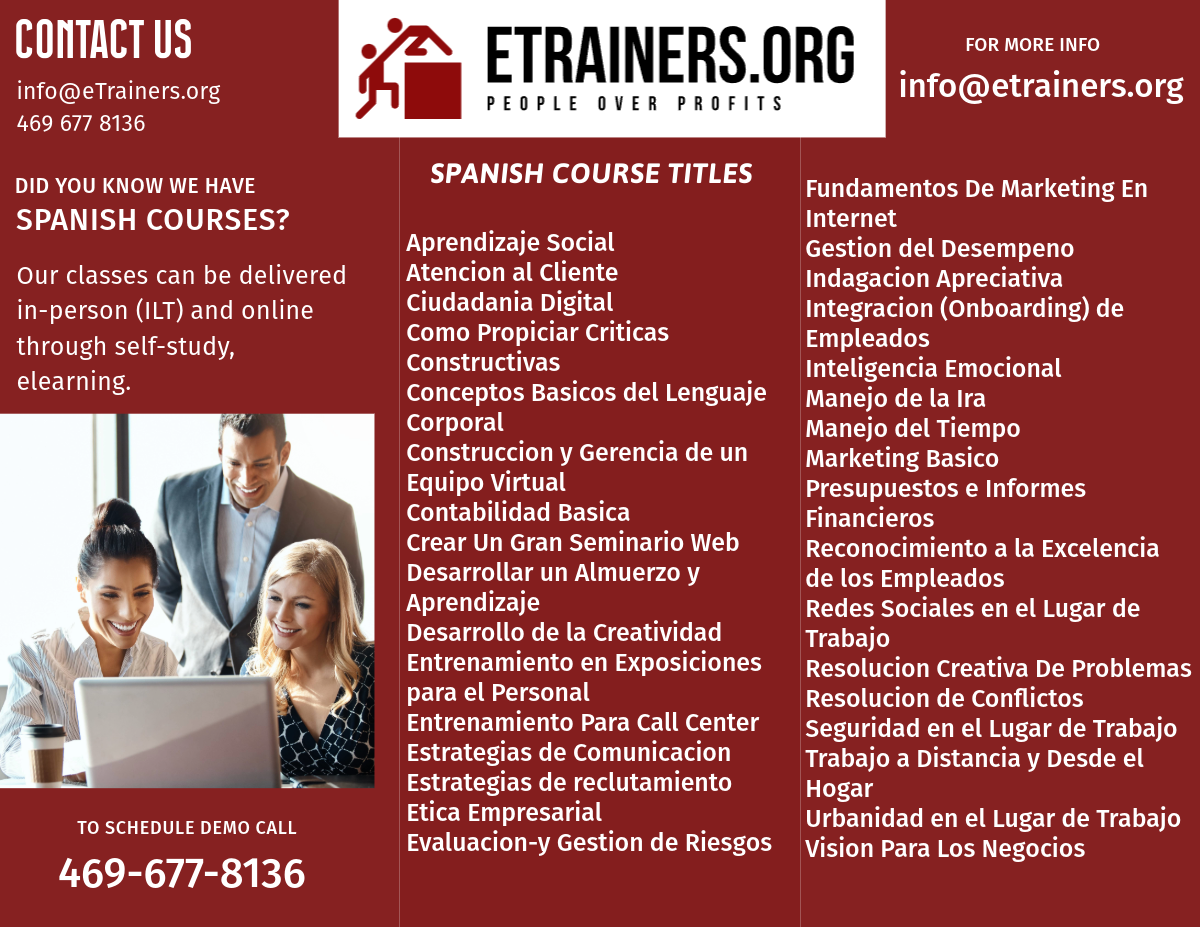
    Visit our Learning Solutions Library for Spanish course descriptions and objectives.

    Book your meeting for your hands-on exploration of our courses.

    Home » Spanish
    Are you not sure where to start?

    Start with our skill gap assessments – they are in Spanish too.

  • Breaking Down Learning Barriers with Spanish Courses

    Breaking Down Learning Barriers with Spanish Courses

    Why Spanish-Language Training Courses Matter for Your Workforce

    When it comes to workplace safety, compliance, and operational excellence, clear communication isn’t just important—it’s essential. Yet for millions of Spanish-speaking frontline workers across the United States, critical training often arrives in a language that creates barriers rather than bridges.

    The solution? Spanish-language training courses designed specifically for the industries and roles where they’re needed most.

    The Reality: A Diverse Workforce Deserves Inclusive Training
    According to the U.S. Bureau of Labor Statistics, Hispanic and Latino workers make up a significant and growing portion of the American workforce—particularly in manufacturing, construction, warehousing, and other frontline industries. Many of these workers are bilingual, while others are more comfortable learning and retaining information in Spanish.

    Here’s the challenge: when training materials only exist in English, comprehension gaps can emerge. And in high-stakes environments where compliance violations carry hefty fines and safety lapses can cost lives, those gaps become serious risks.

    The bottom line? Offering training in your employees’ preferred language isn’t just a nice gesture—it’s a strategic investment in your organization’s safety, efficiency, and legal standing.

    Start with our skill gap analysis (Spanish version).

    Sign up to view our Spanish course descriptions and objectives, and schedule your personal tour of our catalog.

    Book a 15-minute call: